
THE TWO GENDER DICHOTOMY IS NOT AS COMMON SENSE AS IT SEEMS

Challenging the Male/Female Binary
Curriculum Specification
- Course: Sociology, Sexual Education
- Education Level: High School
- Reading Level: 10
- Read Time: 27 minutes, Divided into Subcategories
Sex and Gender Binaries
There’s something really satisfying when things in the real world fit into nice, neat categories of two. There’s Good and Evil. Black and White. Alive and Dead. Good and Bad. Nice, neat categories of two make us happy. These are called dichotomies.
There may be some evolutionary reason for our embrace of dichotomies. After all, in a state of nature where survival is the priority and any misstep can lead to catastrophe, it doesn’t do to spend much time dwelling on nuance. That mushroom is either edible, or not. Now, there may be a great deal of variation between edible and deadly, but breaking the options down to two clear categories makes the decision making process much more efficient. This could be the difference between life and death, eating or going hungry.
The problem with dichotomies, however, is if given enough time and energy to explore the nature of them, one usually finds that the nice, neat categories are rarely as nice nor as neat as initially assumed. That’s why sociologists are often wary when confronted with dichotomies. Sociology and sociologists are dedicated to testing what are considered “common sense notions.” Those nice, neat dichotomies may appeal to our common sensibilities, but they are more often than not hiding much deeper complexities.
Currently, we are engaged in a national debate on a dichotomy that has been central to western civilizations for centuries, the common sense understanding that human beings are divided into neat categories of male and female.
Yeah! What the heck is going on with that? Isn’t it obvious that there are boys and girls?
The nature of the debate centers around how we deal with the existence of people who confound our understandings of what it means to be a boy or a girl in our society. Specifically, people who are born with the physical characteristics of one sex who, for whatever reasons, wish to be recognized as members of a different gender. For instance, a person who was born with male anatomy who insists on being identified as female, or a person born with female anatomy who insists on being identified as male. This might even extend to folks who have no desire to be identified as either male or female.
We may refer to such people as being Transgendered, Someone who identifies as belonging to a gender that is different from their sex identified at birth. We may also be confronted by people who are not easily categorized as male or female regardless of their physical sexual attributes at birth. Such people may be known as Non-Binary.
Yeah, but where did this all come from?
Well, not long ago we weren’t burdened by this debate, but that’s not necessarily a good thing. You see, people who had these feelings, that their genders didn’t line up with their physiology, have always existed. Unfortunately for them, their existence was stigmatized. In other words, they were made to feel ashamed of how they saw themselves. They were forced to hide their feelings, to hide who they were for fear that they would be shunned by their peers, or worse–beaten, maimed, or murdered because they were assumed to be “perverted” and dangerous.
Over the years, however, developments have emerged to encourage Trans and Gender Non-Binary people to become more visible and to self-advocate for more rights and recognition.
First, societies have become a lot more cosmopolitan. In other words, our societies are driven by cultural forces emanating from cities. Urban centers tend to be environments ripe with subcultures, including sexual subcultures. The dense nature of cities often forces different subcultures to interact on a regular basis. Consequently, cosmopolitan cultures tend to emphasize norms and values of cultural tolerance. That’s not to say that tensions do not flare up. However, these tensions are often resolved when both sides decide to “live and let live.” Ongoing contact thereafter tends to affirm that “those people” who seem so different, aren’t really so different after all.
Secondly, the late twentieth century and early twenty-first century saw an active and successful Gay/LGBTQ+ Rights Movement. A noticeable transition began with the Stonewall Riots in New York (an urban center). At the time it was not uncommon for police to raid gay catered bars and social clubs. When the police raided the Stonewall Inn in Greenwich Village the patrons fought back. This started a riot in the community that ended up sparking a conversation about how we treat gender minorities, specifically gay men and women who were doing nothing more than enjoying a night out.
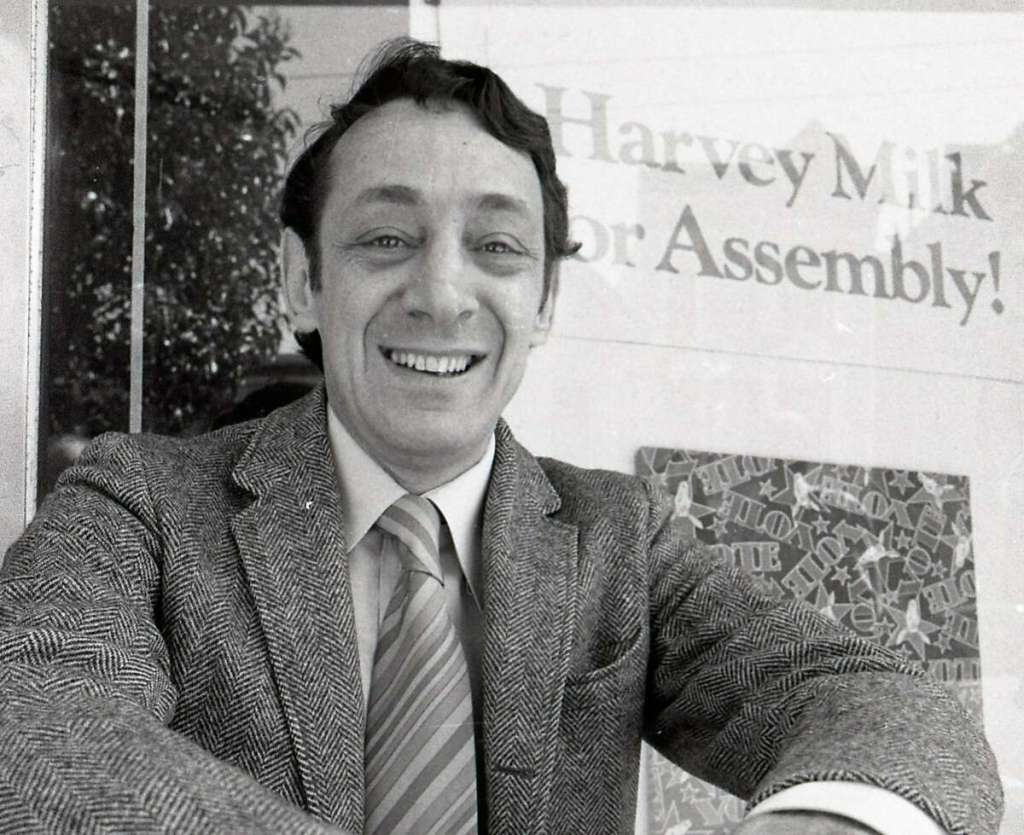
After Stonewall, discourse on gay rights played out throughout the media. Gay characters and gay themes became more common, although often stereotyped, in the media. The presence of gay people in media contributed to normalizing gay identity, making it easier for gay people to “come out” or to publicly embrace a gay identity. This was not an easy or painless process. It took great courage on the part of Gay Rights activists as well as gay celebrities who were willing to risk their careers to come out.1 Greater tolerance for gay people equated to increased opportunities for other Gender Queer people, or those whose gender identity falls outside of traditional categories, to demand recognition.
Also, starting in the middle of the twentieth century, the science and technology had advanced to the point that it was possible for someone who felt they were born into the “wrong body” to do something about it. Gender Affirming medical techniques developed to the point where it is possible for someone to Transition from the sex they were at birth to a body that more closely approximates their gender identities.
These movements conspired to create an environment in which people who do not conform to the strict dichotomy of male and female, the Gender Binary, were freer to express themselves according to their gender identities. The problem was that society did not yet have the norms and values defining how to interact outside of the male/female binary. For as long as we could remember, especially those of us of a “certain age,” the world has been divided between men and women. Maybe some men were attracted to men and some women were attracted to women, but they were still men and women. Now, LGBTQ+ movements were telling us that that wasn’t good enough…and sometimes that is a hard thing to deal with.
I still don’t get it! How can you be born a boy, but see yourself as a girl? It doesn’t make sense!
To be honest, I don’t really get it either. I, the author, am a Cis-gendered, Hetero-normative male. That means, I see myself as a male with a male anatomy who is sexually attracted to women. I like all these things about myself. So, I can kinda sorta understand how a man can be attracted to a man or a woman can be attracted to a woman because that’s not too far outside of my personal experience. I have a hard time understanding how someone with the same biology as me can see themselves as a different gender. That’s really far outside of my experience.
However, when confronted with something that is far outside of our experience, it’s always a good idea to apply empathy as well as reason to those having to deal with experiences and feelings we find alien. Just because I don’t understand how it feels to be a transgender or gender non-binary person should not lead me to invalidate those experiences. Instead, it should encourage me to seek understanding. After all, trans and gender queer people are a fact of life.
So let’s try to figure this out.
The Difference Between Sex and Gender
First, you may have noticed how I used the terms “Sex” and “Gender” above. I was intentional with how I used these terms. Contrary to what you may have heard from others or seen on social media, these terms are not synonymous.
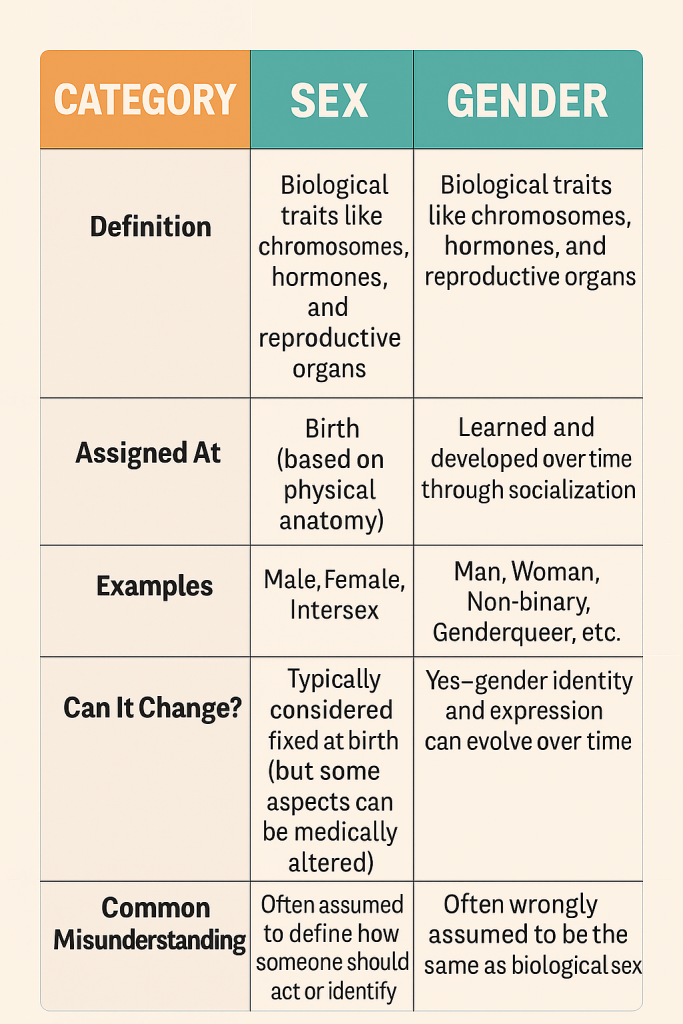
Let’s start with Sex. Sex refers to the biological and physical characteristics typifying males and females at birth. These characteristics include chromosomes, and the physiological responses to genetic development such as the formation of sexual organs and hormones that regulate the body.
Sexual physiology can be divided into primary and secondary sexual characteristics. Primary Sexual Characteristics are those that are recognizable at birth, namely the internal and external reproductive organs. Secondary Sexual Characteristics are those that manifest as a result of puberty such as patterns of hair growth, muscular development, breasts, voice pitch, etc. Terms associated with sex are Male and Female. These terms fit nicely into our dichotomy, but as we will see in a moment, not as neatly as we may have assumed.
Gender is not synonymous with Sex. Gender is the social and cultural roles, behaviors, and expectations perceived as normal for men and women in a given society. In sociological terms, gender is Socially Constructed. Gender is not biological in and of itself.
That’s not what my Uncle Carl says!
He’s wrong.
Gender expectations may be shaped by the physiological constraints of sex. For instance, societies are going to create norms regarding childbirth that will apply to those, namely biological females, who give birth. Regardless, these rules are not determined by biology. They are an interplay between the biological needs of individuals and how societies fulfill those needs. Gender itself is socialized and not permanent. Terms associated with gender are Masculine and Feminine. Again, these terms seem to conform to our understanding of the gender dichotomy, but not completely.
Two Sexes?
Of course there are only two sexes. You have boy parts, or you have girl parts!
Ehhhhh…
Oh for crying out loud! You’re gonna say it’s not that simple, aren’t you?
You know me so well!
It’s true. For most of us a clear designation of male and female works well. We have clearly identifiable boy parts or girl parts. A male has a penis, and testes considered “external” reproductive organs2 with a prostate gland that is internal. A female has external labia and vulva with an internal vagina, uterus, Fallopian tubes, and ova. Easy peasy!
Easy peasy for about 98% of us. For the other two percent, which amounts to millions of Americans, it’s not quite so easy. These are people who were born with some ambiguity associated with their sexual organs. Some people are born with a spectrum of primary sexual traits including well developed female sexual characteristics with some minor development of male characteristics like testes or a penis to a fifty-fifty mix between both to well-developed male characteristics with some female traits. People with a mix of male and female primary sexual characteristics or ambiguous characteristics are referred to as Intersex.

Now, an argument can be made that Male and Female body types with clear primary sexual characteristics are the “normal range” of biological sexual expression whereas intersex characteristics are “abnormal”. Sociologists point out, however, that defining something as “normal” or “abnormal” is more a statement of values than it is a rational response to existing reality. For instance, people with red hair constitute only about 2% of the population, yet we do not define this variation as “abnormal”.
Defining people with Intersex Sexual Characteristics as “abnormal” has certain consequences. Historically, children born with ambiguous genitalia were often subjected to extensive medical and surgical interventions. This is pretty extreme when one considers that, aside from how their genitalia looks, Intersex people are perfectly healthy. Some advocates question why we should subject young children to extensive medical interventions just to get them to conform to a standard binary if there is no other medical rationale?3
Yeah, but you can’t beat biology! It’s genetics! You have a Y Chromosome, you’re a male.
Except when you’re not. There are chromosomal, genetic, and hormonal variations like Klinefelter Syndrome, Turner Syndrome, Androgen Insensitivity Syndrome, etc. I don’t want to get into the weeds on all the variations. Suffice it to say that though in most cases an XY/XX chromosome structure corresponds to male/female sexual characteristics, they don’t always. Again, we may write off such variations as “abnormal” but that does not necessarily align with lived experience. Applying the category of “abnormal” to variations of the norm related to sex differences may have some significant negative consequences.
To put this in perspective, for every one hundred students in your class, it is likely that at least one of them is intersex.
Two Genders?
A critique of the Two Genders Discourse is even easier than the Sex argument. There are cultures out there that recognize more than two genders, therefore the notion of the Gender Binary is not a cultural universal. A quick search of the internet machine suffices. Most noted of these is the Two-Spirit gender recognized by many indigenous American cultures.4 Two-Spirit people often held special recognition within their cultures, often serving special roles such as healers, or keepers of special cultural knowledge.5
Again, it could be argued that all cultures recognized masculine traits, and feminine traits, but some are willing to acknowledge combinations along a spectrum such as biological males who take on feminine characteristics. That may constitute another “gender” but are still based on a binary of masculine and feminine. Regardless, this argument underscores that the concept of gender is better defined on a continuum than on a polar concept of boy traits and girl traits.
We often assume that how masculine qualities and feminine qualities are expressed is the result of natural preferences of men and women. Upon examination, few of our gendered expressions are so easily understood in a wider sweep of cultural history.

Take, for instance, silk stockings and high-heeled shoes. When you think about silk stockings and high-heeled shoes, you are probably thinking about women’s fashion. Today, that’s the norm.
Of course!
But, among our Founding Fathers, silk stockings and high heeled shoes were definitely men’s fashion.
The bottom line here is that norms and values associated with gender are subject to change. There’s nothing about the color pink that makes it a “girl color” or blue that makes it a “boy color.” Indeed, once upon a time, the norm was the opposite. Once upon a time, cheerleading was a male sport. There are many examples of such changes.6
Yeah, but come on. There are some natural differences between men and women that aren’t a matter of culture. Men are physically stronger, for instance.
It’s true. On average, men have a more natural propensity to higher muscle mass than women.
Um…so what? Maybe once upon a time that was an important distinction, but today, the ability to bench press three hundred pounds is cool…I guess…but doesn’t translate much into real life. There are not a lot of life chances and opportunities dependent upon greater physical strength. Even rugged jobs like construction and the military engage technologies that compensate for physical strength.
And difference in physical strength are a matter of degree. Yes, some men are very strong…far stronger than any woman can be. But most of us are not. In fact, there are plenty women who are physically stronger than many men, but those men are still considered men and those women are still considered women.
Look, I’m a pretty big guy. I’m six foot, two-hundred and mumble mumble mumble pounds. I work out. I can probably hold my own arm wrestling with most men…
But if I ever stepped into the boxing ring against World Women’s Heavyweight Boxing Champion Clarissa Shields…yeah…I’d get my ass kicked!

What I’m trying to get at here is that though there are some recognized differences between men and women on average, those differences are matters of degree. Again, they can be identified on a continuum rather than on a strict binary of Man = This and Woman = That. The Gendered categories are constraining and tend to limit human potential. If I have the potential to be a talented chef…it would be a shame to not develop that talent because cooking is a woman thing. If a woman has a talent for carpentry, it would be a shame if she couldn’t reach her potential because working in wood is a man thing.
Fortunately, we live in a society that has evolved to reject these dichotomies and has openly embraced expanded opportunities between the genders.
But what happens when our very concepts of gender are challenged?
Identity is Complicated
Above we challenged the notion of Sex and Gender Dichotomies. Yes, on the surface, there seems to be a common sense notion that Sex and Gender can be divided into two neat categories, Male/Masculine, attracted to women, and Female/Feminine attracted to men. But upon examination, these dichotomies break down. Instead of a clear binary, these notions are better understood as overlapping continua with an impossible to quantify array of options for free individuals7. A male may be masculine in some areas, but embrace some feminine attributes, may be attracted to women, but maybe men, maybe both, maybe neither. He may be feminine in affect but still embrace some masculine interests.
In essence, what we’ve learned is that our Sex and Gender Identities are not simple “on-off” switches between Male, Female, Masculine, Feminine. A better model is one that includes dials that adjust between Male, Intersex, Female on the Sex Dial, Masculine, Feminine, Gender Neutral, on the Gender Dial, and Same Sex, Opposite Sex, Both, Neither on the Attraction Dial. Human Sex and Gender Identity can be a limitless combination of adjustments between these three dials. It’s really pretty cool.

But there is one more element of this model that we have yet to elaborate. Self concept.
What we talked about above has to do with human beings as an objective phenomenon. I have boy parts or girl parts or something in between parts. This is the objective reality of Sex. In other words, everyone can see it (well…not everyone…those special people whom you love very much…you know what I mean!). Gender is how one’s status as a sexual being is expressed. Again, everyone can see how you dress, how you carry yourself, your interests. Attraction is also available to observation. These are all objective elements of human identity and as we have demonstrated, they are much more complicated than assumed through common sense awareness.
Sociologists recognize that human identity is not just a matter of objective, observable phenomena. Human identity is also subjective. In other words, human beings understand themselves from the point of view of others, an objective self, but also through their own internal dialogue, their drives and desires, their inner experiences, or subjective self. We have a self-concept that helps us shape our identities. For sociologists, human identity is an interplay between our inner drives and motives, our understanding of ourselves, and our interactions with others in the world. These are not mutually exclusive. Our inner drives may influence how we interact with others, but how others respond to our interactions will shape and influence our inner drives. Ultimately, human beings are healthiest and happiest when our inner drives align with the expectations of others in our social groups.
Symbolic interactionists offer a good model for how this works. I have a concept of who I am, a self-concept that has developed through reflection and inner dialogue. This self concept shapes how I express myself to others. This can be seen as a performance of self. I will shape my performance based on how I perceive I will be best embraced by others.8 To be accepted I may have to modify my performance here or there. Any modifications will influence my self-concept, requiring internal adjustments. As I interact with others, my performance improves, and those with whom I interact respond positively, which validates my performance, and thus my self-concept. In the event that I perceive my performance to be rejected, I’m devastated. I reject that performance and figure something else out until I find something that works.
This is an often brutal process, the bulk of which takes place during adolescence. This is why adolescence is so awful in many ways. It’s during this time that we are reflecting on our self-concept and shaping our performances for different situations for the first time. Everyday is another interpersonal improv. Think about that first day of school when you know nobody, the uncertainty, the fear. Then you find someone who seems to like you and the sense of relief that washes over you. Think about how that influences your self-consciousness, how much doubt you experienced every day for years while you aligned your sense of who you are with your expression of that inner sense in such a way that aligns with other people’s expectations. Remember how awesome it felt when you got it right, and how devastating and internally implosive it was when you got it wrong.
Over time, you learn the performances that work for you that align with your self concept, and find the audience, the social groups within which you are accepted and comfortable. You succeed in your performance more and fail less. You are no longer doing improv. You have your act down, and it aligns with who you know yourself to be. Life is good. Sometimes, those of us of a “certain age” forget just how hard it was to get where we are. Sometimes we block it out of our memory because it was so awful.

This is a rundown of human identity overall, and we all have an idea of just how complicated this process can be. We all understand that we have a concept of ourselves that in some ways align with how others see us, but in some ways do not. We also understand that in some ways we shape our self-concepts, but in other ways we do not. For instance, I have a concept of myself as a youthful person. Then I look in the mirror and see that my beard is pretty much white. That does not align with my understanding of myself as a youthful person. I’m forced to evaluate my self-consciousness with my physical reality. Nobody would think twice if I decided to dye my beard to make my physical reality align with my internal understanding of who I am.
This leads us to the concept of Gender Identity. Gender Identity is one’s deeply held understanding of who they are as it relates to gender norms and values. In other words, how do I see myself as a man or a woman. For most of us, if we have boy parts, we see ourselves as male and more or less masculine. It’s really easy.
It’s not so easy. When we look in the mirror, we don’t just see what is there. We see a reflection that is filtered through biology and neuro-chemistry, through personal experience, through socialization, through cultural expectations. There are endless variations of influences over how we see ourselves. Some of these variations we may be able to control. Others we cannot.
Just as there are almost infinite combinations between who we are sexually, and our gender and attraction, there are endless filters through which we see ourselves. Most of us can look at our bodies and understand ourselves in alignment with our physiology. We have boy parts, we see ourselves as male. We have girl parts, we see ourselves and female. This is true even if we don’t see ourselves as masculine or feminine, or attracted to the same sex or opposite sex. There are many variations.
Knowing this, it should not be a surprise that self-concept is more complicated than it seems. For some of us, the self-concept regarding our gender does not align with our sexual configuration. We may have boy parts, but we understand ourselves as girls, or vice versa. If sex can be more dynamic than common sense would dictate, and gender can be more diverse than common sense might dictate, and sexual attraction is more expansive than common sense might dictate, why is it a surprise that Gender Identity exhibits the same kind of complexity?
Wow! I’ve never really thought of it like that.
This is a big deal. Remember, our identities constitute an alignment between how I see myself with how others validate how I express myself, my performance. To develop into a healthy person, with a strong, positive identity, I must be free to make the millions of adjustments required to align the objective self I present to the world with the subjective self that I recognize as “I am…”
If “I am a girl” subjectively, but objectively I appear to be a boy, there’s a problem of identity that needs to be resolved. For centuries in our culture, this conflict between one’s subjective understanding of their sex/gender and their objective performance of sex/gender was resolved through imposition. Gender Expression, the behaviors, actions, and affect one demonstrates with relation to their gender, was to align with one’s objective sex, the gonads they have. If I have girl parts, I’m a girl. If I see myself as a boy, then I’m just going to have to suppress my self-concept and express myself as a girl. I must deny my subjective self in the interests of my objective self.
When we think about it, this is a rather arbitrary imposition. Forcing a person to sublimate their subjective understanding of who they are in the interests of satisfying other people’s objective expectations of them is a selfish norm. It may comfort others, but comes at the expense of the individual.
On one hand, this is not uncommon. We all experience constraints on our subjective selves. Your school may have a dress code. That’s a constraint on how you express yourself. On the other hand, asking me to constrain my choice of t-shirts is qualitatively different than requiring me to deny my Gender Identity.
This is especially the case when we consider that all forms of Gender Expression are, in essence, a performance.9 In our society, how we perform gender, objectively, does not involved our genital configuration. We would be arrested if it did! Yet we have created norms and values that impose strict alignment between Gender Expression…which we are allowed to see…and one’s genitals…which we are not allowed to see.
Um…er…Uncomfortable conversation talking about genitals.
Yeah. Imagine what it’s like for a Trans-gendered or Gender Non-Binary person who is expected to bridge this gap. Somehow, our society can’t stop talking about transgendered genitals! For some reason, a politically influential bloc in our nation is devoted to making sure, through legislation, that one’s Gender Expression aligns perfectly with their genital configurations…and not even the genital configurations they have, but rather the genital configurations they were born with…assuming they were born with the right configuration which may not be the case…
I could go on.
No. I think you made your point.
The Takeaway
Sex, Gender, Sexual Attraction, Gender Identity. Once upon a time these were divided into nice, neat, common sense dichotomies. Anyone who did not align with the dichotomies, even a little bit, were often defined as pathological and stigmatized.
Today, we live in a society in which people of the same sex can be married, and most of us do not bat an eye. When I was a kid, the very notion would have been ridiculous. Today, it is accepted as valid by most people. This took time and required the energy of countless activists, often at great personal sacrifice, to make the claim that a gay person is, first and foremost, a person. That as a person, they have the same rights as anyone else, including the right to marry whom they love. Their argument was unassailable, and LGBTQ+ people gained the recognition of their rights…at least for a time.
It’s important to remember that the norms established by recognizing the rights of LGBTQ+ people are fairly new, and they are not universally accepted. There are those who would like to go back to the way things used to be. We must remember that the way things used to be was sustained only by imposing considerable pain and suffering on a vulnerable minority.
That being said, there are legitimate debates for which we must come up with a consensus. Norms and values are negotiated at the social level. For centuries our culture has been based on the assumptions of a Gender Binary. It’s only been a few decades that we have accepted norms that define both genders as having equal rights. We have guaranteed the rights of women to participate in sports, to pursue careers, to enjoy life chances as equal to those of men. That’s huge! But these rights are still understood in accordance with a common sense notion of a Gender Binary.
Now what happens when we challenge the Binary itself?
Well, that’s what we’re going to find out. There will be those who are stalwart in their defense of the traditional Gender Binary. Others will be willing to innovate, to alter their pre-conceived notions. The one thing neither side can afford to forget is that we are talking about human beings on all sides of this equation. Society is best served when we find solutions to our conflicts that respect the rights and dignity of all involved. The traditionalists are not entirely wrong about their concerns for fairness in sports, or the consequences of medical interventions on minors. The liberals are not wrong in making the claim that people should be free to express themselves according to their desires. The trick is, how do we develop the norms that mitigate these concerns while at the same time respecting the dignity of all involved? If that is our focus, if we eschew fear and anger and bigotry, we’ll figure it out together.
Notes and Sources
- This story is huge and goes way beyond this particular lesson. A big part of the story has to do with organizing around AIDs that was devastating the gay community in the 1980’s, with little response from the new conservative movement at the time. Speaking out for the gay community was not just a matter of “live and let live.” At that moment it was a matter of life and death. ↩︎
- By external we mean external to the pelvic girdle. ↩︎
- It’s important to note that surgical and hormonal interventions on intersex people is Gender Affirming Care. It’s the same kind of medical intervention used by trans people to transition into a sex that aligns with their gender. We often don’t think to question Gender Affirming Care for intersex minors, but some find such care inappropriate for trans minors. ↩︎
- This idea of the Two-Spirit is an umbrella term. Not all Native American cultures recognized this Two-Spirit, and among those that did, there are different norms and values associated and terms applied. But overall, ↩︎
- Native Americans are not the only cultural group to recognize more than two genders. Again, I don’t want to get into the weeds on this. If you want more information, you can click here. Suffice it to say that the commonsense notion of a masculine/feminine gender binary is not a universal understanding of gender. ↩︎
- When your Uncle Carl complains about how men are becoming “feminized” he’s really not talking about much in particular. He’s pointing out the very normal historical process of cultural change. He may not like how these changes are manifesting, but that’s cultural evolution for you! ↩︎
- Assuming that they are free ↩︎
- Goffman, Erving. 1959. The Presentation of Self in Everyday Life. New York: Doubleday. ↩︎
- Butler, Judith. 1990. Gender Trouble: Feminism and the Subversion of Identity. New York: Routledge. ↩︎
 Mr. A's Underground Classroom