

Or why no one is got when there is a “gotcha” moment
By Professor Rod Graham, Old Dominion University

Sociology of Knowledge
Note: I’ve been planning a more comprehensive set of explainers on political philosophy and ideology for some time now. This is a response to my personal experience that students, even at the college level, often have no idea what terms like “liberalism” or “conservatism” mean. They often associate the terms with a political party. Very often, they simply ascribe an out-group definition. For instance, a Democrat may associate “conservatism” with racism, or a Republican will define liberals as big government elitists. Such assumptions betray the fact that liberalism and conservatism are coherent ideologies with a history and an associated value system. I’ve seen both liberal and conservative identified students stare at me with confused eyes after a lesson elaborating the differences and say, “that’s not what I thought it was. That’s not what I believe at all!”
In the planning stage I thought it would be a good idea to discuss the term ideology before elaborating more specific lessons. I put a post on ideology on my “to do” list. Then I read this post by Professor Rod Graham. I thought, ‘Wow! That’s my introduction right there.’ I mean, I would have gone into Marx a little more in depth and worked in some Karl Mannheim, but Van Dijk is a probably an even better choice. Regardless, it’s one less post that I have to do. Professor Graham was good enough to allow me to blurb his explainer on the Underground Classroom. I’m proud to introduce this piece as a guest contribution.
Curriculum Specification
- Course: Sociology, Government
- Education Level: Advanced High School, College
- Reading Level: 11th grade
- Reading Time: 9 minutes
When you hear the word “ideology,” what comes to mind? I reckon most folks would say something like: ideas people have about the world. If I asked for an evaluation of ideology—good, bad, or neutral—most folks would say ideology is a bad thing. An ideology is a false belief. Or it’s something used to justify the mistreatment of people.
Well, here’s how ChatGPT defines it:
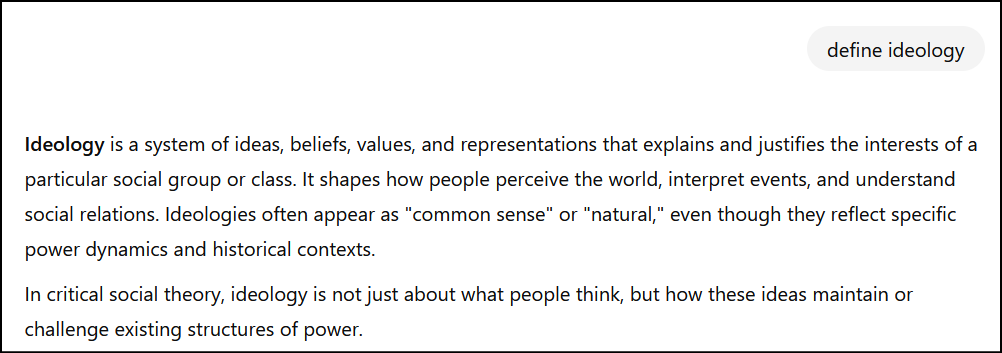
If I asked someone what ideologue means to them, I suppose I’d get something similar to Sir Winston Churchill’s description of a fanatic: someone who can’t change their mind and won’t change the subject.
With respect to both ChatGPT and Sir Winston, I think this view of ideology—and of ideologues—leaves much to be desired.
The many ideologies of Teun A. Van Dijk
Dutch sociologist Teun A. van Dijk understands ideology differently than most of us. He outlines his theory in the 2006 work Ideology and Discourse Analysis. The article, as the title suggests, begins with a description of ideology and then turns to a method for analyzing it that he terms discourse analysis. I will focus on the first part of the article—his theory of ideology.
To summarize Van Dijk: An ideology is
a stable system of beliefs shared by a group of people that organizes the group’s behaviors and communication.
Here are some ideologies Van Dijk mentions in his seminal article: sexism, pacifism, feminism, socialism, the anti-nuclear movement of the 1970s, and neoliberalism. He also refers, more generally, to professional organizations, whose members share the ideology adopted by their profession. Van Dijk’s article, though written in 2006, predates contemporary movements like MAGA or the push for trans rights. Still, his framework readily applies to such ideologies.
Ideologies perform several functions for Van Dijk:
- They bind a group of people together. Indeed, if there is no group of people who adopt the beliefs and use them as a basis for communication, there is no ideology to speak of.
- They form the cognitive basis of a social group’s self-image: “I and the people I identify with think this about the world.”
- They provide rationalizations and justifications for the group’s identity, norms, values, and attitudes: “The morals and values we hold, the policies we support, the things we do, the things we build—these are grounded in this set of beliefs.”
- They shape how the group relates to other social groups: “Because of this set of beliefs, we think those ‘others’ who do not share them are wrong, immoral, or dangerous—and this is how we should treat them.”
So far, this may not sound terribly different from how most people think of ideology—if they were compelled to think about it. But let’s dig a bit deeper into Van Dijk’s theory.
There are many types of ideologies.
In his article, Van Dijk discusses ideologies such as sexism and feminism, which we might call social ideologies, though they also carry political implications. He also mentions socialism and neoliberalism—economic ideologies, likewise politically charged. He even includes the anti-nuclear movement, a grassroots movement much like Black Lives Matter, as an ideology.
This, I believe, marks a departure from how ideology is commonly understood. In everyday thinking, belief systems we dislike, such as communism, are often labeled as ideologies, while belief systems we favor, such as capitalism, are treated as common sense. Van Dijk points out—correctly, I believe—that both are ideologies: stable systems of beliefs shared by a group of people.
Click Here to read the full article at Prof. Graham’s Substack, The Neighborhood Sociologist.
 Mr. A's Underground Classroom