FLORIDA HAS ACCEPTED MY OFFER
In January of 2024 the parent of one of my students, who also happened to be an activist with the Florida Citizens Alliance, sent the following text message to my school district’s Deputy Superintendent, Dr. Jennifer Cupid McCoy:
“Hey, I know you’re busy, and I hate to bother you , but [student’s name] just
got home from work, and we were talking about school. She has a new
class, economics and I have a HUGE problem with her teacher, and I
need you to talk me off a ledge because I’m level 10 mad. This “teacher”
started the class today by offering to use whatever pronouns the students
wanted , and he made point to tell them that he doesn’t care what the
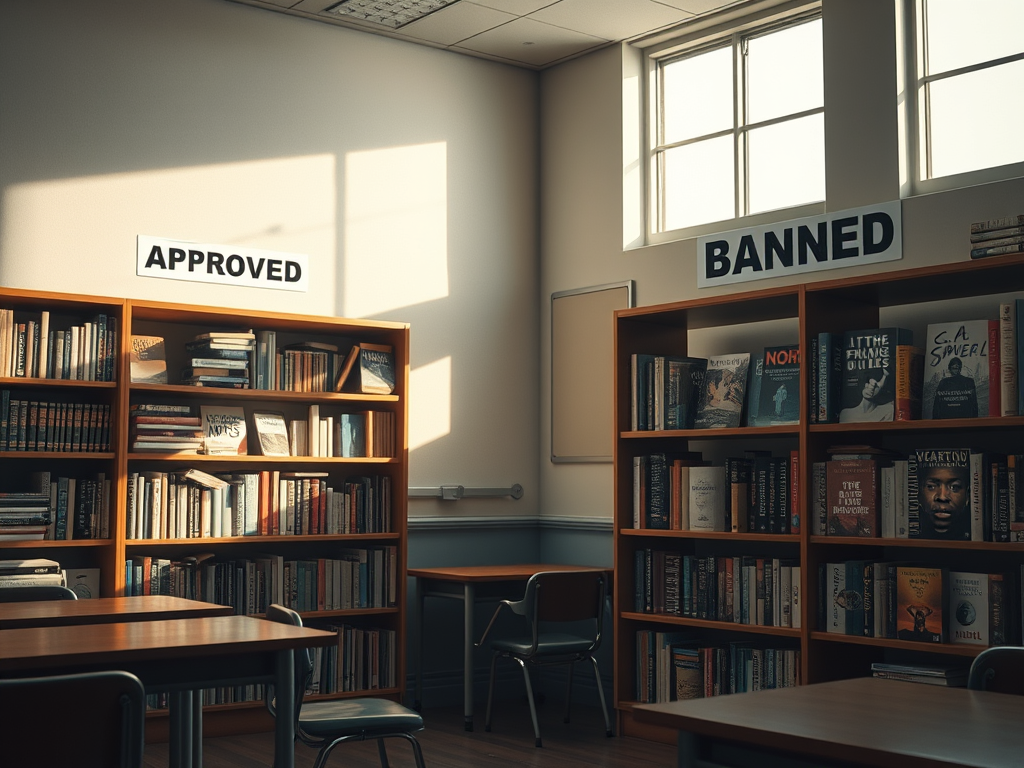
governor says. He also has two bookshelves in his classroom , a green for
District approved books and a red for BANNED books, he told them to
choose from any bookshelf they want. And to top it off, he stressed the
importance of voting because they’re all going to be 18 if not already, so
one can only imagine the political garbage he’s going to be force feeding
them all semester. This is blatant insubordination, and I am beyond livid.”1
Remember, this was a text message. This activist parent had a direct line to the Deputy Superintendent.
Without coming to me and asking for my perspective, the district initiated a formal investigation into my conduct. To be clear, I was being investigated for 1. Allowing my students to have access to books, and 2. Respecting the human dignity of my gender non-conforming students. Be that as it may, the district investigation automatically set off a state level investigation.
A couple days later, my principal and, if I remember correctly, Deputy Superintendent Dr. Cupid McCoy, visited my classroom. I didn’t think anything about it. They were all smiles. It was not uncommon for my principal to bring district officials into my classroom to see me teach.2 They stuck around for about two minutes, smiled at me, waved at me, then left. What I didn’t know is that the visitor was there to check if my bookshelves were covered. Of course, they weren’t covered.
That weekend, most of my books were physically removed from my classroom.
After talking to my wife and daughter,3 I decided that this was a push too far. I was already skirting the edge of my moral values trying to navigate the regressive, authoritarian restrictions on teachers here in Ron DeSantis’s Free State. When my books were removed, I realized that there was nothing more for me to give. I had reached the end of what I could swallow. I submitted my resignation.
It was only after I submitted my resignation that I learned that I was under investigation. I wasn’t told why I was being investigated. I didn’t learn that until I submitted a public records request. I joked that Kafka was not on the vetted reading list here in Robert E. Lee County Florida. I joked, but it’s really not funny.
Much to my surprise, my letter of resignation went viral. I found myself the center of attention and thought I would use that attention to put a spotlight on the medieval conditions of teaching here in the Free State of Florida and to speak out against right-wing policies that have marked Florida as number one in book banning and infamous for its full-frontal assault against academic freedom.
I elaborate the full story here:
Well, today, just over two years after I submitted my letter of resignation, this particular saga is over. The State of Florida has officially accepted my settlement offer. To be clear, I settled because I believe that there is no avenue by which I would get a fair hearing in the so-called Free State. A teacher with a background in leftist politics, accused of letting students read books, and treating his transgendered students with respect and dignity, is subhuman here in DeSantisland. So, my lawyer, provided by my union, the Florida Education Association, fought tooth and nail to get the best deal for me he could.
I agreed to what amounts to a “no contest” plea. I had no problem with this because I have no problem with the public record showing that I, as a teacher, let my students read books, and respected their human dignity. In return, I will keep my teaching certificate pending the following:
- I will spend a year on probation starting whenever I return to the classroom, and pay a $150 fine.
- I will pay another fine of $500
- I will complete a…wait for it…wait for it…Ethics in Education Course!4
To this day, nobody has asked for my perspective on this matter. No official has asked me a single question about the accusations leveled against me. I did, however, have the opportunity to offer a written response to these allegations. You can read my response below. It’s long, but I think it is worth it.
As it stands, this surreal chapter in my life is now closed. I will continue to fight for academic freedom here in Robert E. Lee County, the state of Florida, and the United States from whatever modest platform available to me. I thank my family and friends, even the conservative ones, for their support. I thank my union for providing the legal resources.
If you are a teacher, especially here in the Free State, and you are not a member of your union, join. Remember, this whole mess I just went through was the result of one parent sending a single text message.
Response to the Florida Education Practices Commission
I approach this response with mixed feelings. On one hand, it is the culmination of a disheartening process that has taken almost two years to resolve. On the other hand, this is the first, and only time in this twenty-month investigation that I actually have input into matters determinative to my future as a professional.
One would think that the first thing any responsible and ethical investigation would do is document the point of view of the principal target of that investigation. Clearly, this is not how Florida Department of Education investigations work. All along the way I was assured that I’ll be able to tell my side of the story once the investigation is concluded. What’s the point of giving my side of the story after an investigation? Nobody involved in the chain of events leading up to and corresponding to this investigation has ever bothered to talk to me. To this teacher, and to all the peers I’ve spoken to, this demonstrates the overall disdain that the Florida DoE and the Lee County School District have for teachers in their employment.
To put this in perspective, I was initially informed that I was under investigation in mid-January 2024. On January 16, I entered my classroom to find that almost all my books were removed. My bookshelves were bare. Over six hundred books, many of which had been in my classroom library for ten to twenty years with not so much as an eyebrow raised, had disappeared. As a bibliophile and free speech, anti-censorship activist for almost forty years, I was so outraged I could hardly speak. I was nauseous by what I was seeing in my American classroom. This was stuff I had only read about happening in authoritarian states. Now I was living it.
I texted my wife and she advised me to leave right then and there. I couldn’t bring myself to do that. I was still a teacher. I still had responsibilities for my students and my school. I always taught that decisions should never be made in anger.
I later learned that my students were being pulled from their classes, their instructional time disrupted, so the Assistant Principal could interrogate them over my book policy and use of personal pronouns.
Frankly, if there was one factor that outraged me more than having my books removed from my classroom, it was the fact that students were pulled from their classes, denied instructional time, and asked to inform them about their teacher’s behavior. I wonder if these students’ parents were informed that their children would lose instructional time to participate in this investigation. I also wonder if the Assistant Principal informed the parents and children that their names and testimonials would be public record, available to anyone who cared to look. They were not speaking anonymously. I wonder if parents and students were given a choice to participate in an investigation of their teacher. After all, this is supposed to be about parents’ rights—isn’t it?
At that point, it was clear that this wasn’t about me. This was about making an example out of me as a warning to other teachers. Do not stick a toe over the line. You are being watched. I have a visceral antipathy to being used toward someone else’s ends. And yet, to this point, I still had no idea whose ends and what those ends were. However, I certainly had no faith in my employer, nor in the state, to be concerned about my interests. Every teacher in Florida understands that they are on their own should even the lightest suspicion fall on them. I talked to my wife and my daughter and decided to take matters into my own hands. As I said in my letter of resignation, “The teacher that I am and have always aspired to be is incompatible with the current regressive and authoritarian atmosphere that now imbues Florida and Lee County Schools.” I submitted that letter on Wednesday, January 17th.
As I was driving home, the Director of Personnel Services, Fernando Vazquez, called to inform me that I was under investigation. I fear I may have been combative in this conversation. I asked him what the investigation was about, but he told me that everything would be clarified after the investigation was concluded. He did make some inference to books and pronouns, and did, albeit indirectly, let me know that this investigation was a response to a single parent complaint. No further information was forthcoming by him or by formal written notification a few days later. I quipped to a colleague later that week that it was clear that Kafka was not yet on the vetted list of approved reading.
I remained in the dark as to the nature of this investigation until I received the results of the public records request I submitted on the matter. It turns out that a parent, who also happened to be a high-ranking, right-wing activist with the Florida Citizens Alliance, was informed by her daughter, one of my new students, that I was using students’ preferred pronouns and allowing students to have unrestricted access to my classroom library. At this point, the parent could have reached out to me. My email address was on the class syllabus and posted on the school website. All parents had access to my Google Classroom and my class website. Had she reached out to me, she would have learned that her daughter’s claims were exaggerated. As a professional, I could have assuaged any of this parent’s concerns. I must wonder the extent to which this parent’s political agenda took priority over her and her daughter’s relationship with their economics teacher.
She certainly did not take the rights of other students and their parents into consideration when she texted the Deputy Superintendent, Dr. Jennifer Cupid-McCoy. Now let’s not get bogged down in the fact that this political activist had and used a direct, personal line to the Deputy Superintendent, or that the Deputy Superintendent and the Director of Personnel Services had no problem with bypassing Lee County School District Policy regarding parental complaints. I guess the requirement for “neutrality” only applies to teachers, not district personnel. This political activist did not call my school and talk to my admin. She jumped the line…because she could. It’s clear that some people, enjoying the privilege of sharing the right politics, also enjoy the privilege of bypassing policy and process at whim. Every teacher in Lee County understands that if there’s a choice between following the policy in the interest of the teacher or simply throwing the teacher under the school bus, the latter course will be taken every time.
The formal investigation began days before my books were removed. I continued doing my job blissfully unaware that anything was amiss. At one point my Principal, Deborah Diggs, escorted Dr. Cupid-McCoy to my classroom. I was engaged in a class discussion with my Philosophy students. Principal Diggs and Dr. Cupid-McCoy entered my classroom with smiles on their faces, looked around the room, smiled, waved at me, and left. I thought nothing of it. As a highly effective teacher, my principal often brought district visitors to observe my class. Class discussion went on without interruption. I had no clue that their intentions were less amicable than the plastic smiles on their faces. They were no more than fifteen feet away from me, yet neither of them bothered to reach out. Nobody at any level asked for my side of the story.
If someone had simply asked me, they would have learned that the circumstances were not as dire as this political activist parent made out. They would have learned that though the policies at that time regarding personal pronouns and the censorship of books violated every fiber of my deeply held personal values, that my classroom policies were a sincere attempt to balance the line between what I know to be morally abhorrent, and the satisfaction of the authoritarian and bigoted polices of the state and district. My classroom policies represented my best effort to align my professional and ethical responsibilities to state and local policies that contradict those very values.
Indeed, had my administrators and my district been in less of a rush to demonstrate their fealty to the right political operatives, they would have learned that my classroom policies aligned with clarifications of the relevant laws issued by the state just a few weeks after I handed Principal Diggs my resignation. Over a hundred students could have enjoyed instruction from a trained professional who knew his subject matter rather than from substitutes with no background in the complex disciplines of Economics, Sociology, and Philosophy.
Though I endeavored to continue to provide learning materials to my AICE Sociology students for the rest of the year, I can’t help but wonder how many of them would have passed the AICE Exam had I been able to, in good conscience, finish my contract. Did any of them miss out on a Cambridge Diploma? Did any of them miss out on their Florida Bright Futures Scholarship? I hope not. I tried even after resigning, to help these students.
Of course, nobody reached out to me. I was kept in the dark. I was kept in the dark because ignorance is the foundation of an authoritarian structure. The ignorant cannot fight back. Consequently, this document is my first opportunity to address the claims made against me in this investigation.
Toward that end, let’s review the claims under investigation. Of the allegations made by the aforementioned political activist, two were formalized. According to the Probable Cause Determination, I am alleged to have encouraged students to provide me with their pronouns that did not accurately reflect their birth gender, and gave students access to controversial information not approved by state law.
These material allegations were then broken down into four counts against me. Count 1: I violated the Principles of Professional Conduct prescribed by the state board. Count 2: I failed to make reasonable effort to protect the student from conditions harmful to learning or to the students’ mental and physical health and safety. Count 3: I violated state statute as it relates to personal pronouns. Count 4: I failed to distinguish between my personal views and the views of the school for which I worked.
From my perspective, I was under investigation for two reasons. First, I was allegedly being respectful to students subject to marginalization by the state. Secondly, I was allegedly allowing students access to books. My first claim is that both actions are not only consistent with state and district standards of professional ethics, but also in conformity with the enlightened values of any free society. My second claim is that Florida state statute puts teachers subject to this law in a double bind. In the Free State, teachers can either follow the dictates of immoral and bigoted laws in violation of the Principals of Professional Conduct, and in many cases their personal consciences, or risk being sanctioned by the state for respecting their students’ dignity and encouraging them to read.
Addressing my first claim it is important to understand the context. My school is well known within our district for being accommodating and tolerant of gender non-conforming students. It is a safe space for LGBTQ+ kids and consequently attracts a disproportionate number of such students. At the time, I was the sponsor of North Fort Myers High School’s Gay/Straight Alliance—Pride Club. Consequently, my electives attracted a disproportionate number of LGBTQ+ students. I was their advocate. I believe advocating for students, especially those students disproportionately subject to abuse and bullying is consistent with a teacher’s professional ethics. Unfortunately, such advocacy is not politically expedient when the state has taken on the role of bully and abuser.
It is in this context that I find myself in that double bind described above. I know these young men and women. I know they are not confused. They are not sick. Many of my transgender students had their parents’ support and were happy to be undergoing gender affirming care. I had young, transgender men with tenor voices and facial hair. It’s absurd to ask me to police my own pronoun usage because the state mandated grammar for referring to this student is she/her.
Many of my gender non-conforming students were still trying to figure their identities out. I referred to this as “trying on gender.” Their identities would change throughout the year as they endeavored to find their comfort zones. I supported them through this process. I gave that support when Cindy was a she, or when Cindy decided she was Charlie, and then the next week when they realized they were Cali. This is consistent with the support I gave my cisgendered, masculine students who were more interested in chess than in football, or my cisgendered, feminine students who had a talent for arm-wrestling and could elaborate on the challenges a boxer with reach has when confronted by an inside fighter.
I support them because I am a sympathetic and empathetic human being, intrinsically motivated to help others. I do this because I am not afraid of diversity and therefore do not hate people for being different. I do this because I grew up watching Mr. Rogers and took him seriously when he told me to first be kind, second, be kind, and third, be kind—turns out, this was an early lesson on the philosophy of Henry James. I had no idea. That little fact was something I learned when I was planning the curriculum for North Fort Myers High School’s first Philosophy elective. Connecting Henry James to Mr. Rogers. What a great lesson that would have been. I was looking forward to teaching it later that month. However, thanks to this one parental complaint, I never got the opportunity to indoctrinate my students with this woke ideology. I’m sure the state sees that as a win.
I do not need scientific research to justify treating people with basic human dignity. That is part of my moral DNA. Though I do not need this scientific research, I have it. I know that my transgender and gender diverse students are more likely to experience bullying and harassment at school and are more likely to experience negative mental health outcomes including suicidal ideation. Trans students are five times more likely to commit suicide than their cisgendered peers. One in four of my transgender students will attempt suicide. I know from reason, from research, from empathy and simple human compassion that the presence of one supportive adult can be the difference between life and death for any of my students, most especially my trans and gender diverse kids.
Which leads me to question this body’s dedication to the values expressed in Claim 2. As a teacher, let alone a reasonable and compassionate human being, the state and district mandated that I violate my personal values and my professional ethics by denying an identified category of students the simplest expression of respect and affirmation and in doing so, increased the probability that that student will die. As a teacher in the Free State, I had a choice. Follow the law and risk the possibility of contributing to a child’s death, or break the law and jeopardize my career, my ability to care for my own children. Or leave the profession. This is the kind of choice matrix imposed by authoritarian regimes. In the end, explaining my actions to this body is a small matter when compared to the possibility of being responsible to my own conscience in the face of the death of a child. What is this body in comparison?
Just over two months after the start of this investigation, it turns out, the state reached a legal settlement with Equality Florida clarifying the intent of Florida State Law. It turns out that the allegations made by this activist parent were moot according to the expressed clarification. These allegations were further weakened when the Supreme Court ruled in the 303 Creative case that the state cannot compel an individual to “…speak in ways that align with its views but defy…conscience about a matter of major significance.” Yet the investigation continued because everyone knows that teachers surrender their rights upon certification—Justice Abe Fortas and Tinker be damned!
What about the second matter, that I allowed students access to books? According to the Statement of Probable Cause, I went outside the curriculum when I gave students access to controversial material not approved by state law. Now, let’s put aside the thoroughly unamerican and unenlightened notion that information must be approved by state law before one can have access to it. This is about the fear of indoctrination. Somehow, it has been determined that the state is the best arbiter to protect citizens from indoctrination. This is a confusing matter because the Governor has stated unequivocally that the intent of the law is not to force teachers to cover their books. In fact, according to the Governor and his administration, teachers covering their books were nothing more than political activists intent on giving the law a bad name. According to the Governor, HB 1069 was a commonsense statute designed to keep pornography out of children’s hands. Who could be against that?
That’s confusing. I was unaware of any teachers sharing porn with students, let alone that this was such a huge problem in the Free State that it required specific legislation for the classroom. So, I looked it up. It turns out, I could find only two well reported cases of teachers sharing sexually explicit material with students in the last twenty years, though there may have been a smattering of lesser-known incidents. These incidents were dealt with by law enforcement because it turns out it’s already illegal to share pornography or sexually explicit material with minors.
Regardless, in May of 2023 teachers in my district were required to scan all the books in their classroom library into a central database. I had almost seven-hundred books in my classroom library—exactly none of them were pornographic. Still, I complied with this morally reprehensible law. After twelve hours of scanning, my entire library was uploaded to the database. We were told that the books would be vetted over the summer, and I would then have a list of approved books and a list of inappropriate books to be removed from my shelf. The teachers I interacted with all knew that we did not have pornographic books in our classrooms. We weren’t concerned about that.
What concerned us was that little asterisk whenever policymakers talked about porn in schools. They always spoke of pornography and “other inappropriate materials.” What were these other inappropriate materials? The message from the state that specifically banned The 1619 Project from classrooms, censored African American history, and had declared war on WOKE and rainbows was clear. Many of my peers decided not to take any chances. They emptied their classrooms of any materials that might be considered DEI or Critical Race Theory including books by Black authors, books with LGBTQ+ characters and themes, books critical of the state, books that confronted bigotry.
They were not wrong. Florida is now known throughout the country as the number one state for banned books. In fact, I’ve been out of the country a few times since this incident, and I can tell you the reputation is international. Research by PEN America confirms this reputation. Florida public schools are ground-zero for this form of legal arson.
In August of 2023, I returned to school and opened my email in anticipation of that state vetted list of books. I was expected to remove any rejected books from my classroom immediately. I had every intention of challenging every single rejection through the formal process. My preparation for combat, however, was preempted. There was no list of rejected books. Indeed, there was no list of approved books. None of my books were even looked at. I had almost seven hundred books in my library, but according to district policy, in conformity with the expectations of the state, I couldn’t let students read any of them. My books were not banned, per se. They were just not not banned. So, my students couldn’t read them. But that’s not the same as banning them. They just weren’t approved for reading. It makes perfect sense.
Shortly before open house, the teachers in my district were required to cover or lock up any unvetted books. I complied. I had five bookshelves in my classroom, and I covered each of them. It turns out that this was, according to the Governor, a violation of the intent of the law. Maybe the Lee County School District is chock full of far-left radicals and Marxists trying to make the Governor look bad. Or maybe the Lee County School District is chock full of bureaucrats intent on covering their own…uh…assets.
Again, the context is deeper. This was a school district that had for years encouraged teachers to create “reading rich environments” in their classrooms. Teachers were expected to have large classroom libraries with diverse reading materials that students could access. These libraries were not limited to the curriculum. They were to include books that were of “student interest.” The idea was to encourage students to explore books and the ideas contained therein. I’ve always said, books are the bricks of a free society. If there was one policy in this district that I embraced wholeheartedly, it was reading rich classrooms.
Now I was required by this same district to cover my bookshelves until these books could be vetted by someone whom I did not know, who did not know me, did not know my subject area, and did not know my students.
Again, I complied, though I did so maliciously. On each of my shelves I included a sign explaining that “These Books Have Not Been Vetted by the State and May Contain Dangerous Knowledge…”
As I looked around my classroom, half-covered in project paper, I realized that this was not a healthy learning environment. As parents filtered into my classroom, most tried to ignore the obvious absurdity of covered bookshelves. Many parents, however, were outraged. One parent was explicit. Her daughter loved to read. This parent gave me blanket permission to allow her daughter to read any book she wanted without interference. This was, after all, about parents’ rights…just not this parent. Her rights didn’t count.
After the parents left I informed one of my administrators that I could not teach in a classroom with covered bookshelves. It was absurd and distracting. I informed this administrator that I was taking the project paper down and would develop another system for satisfying state and district requirements that also encouraged students to read. My system included a green apple crate for approved books and a red apple crate for rejected books. I justified this red crate in the face of policies requiring me to remove books that were on my rejected list because, when I challenged the rejections, the program removed them from the rejected list pending review. I wanted the students to see the consequences of this medieval policy.
By January of 2024, only forty books found their way into the green apple crate. Five books were in my red apple crate. None of them were pornographic. They included Monster by Walter Dean Myers, As I Lay Dying, by William Faulkner, and Their Eyes Were Watching God by Zora Neale Hurston. This system was in place for a full semester with no problems. School administrators entered and exited my classroom on multiple occasions.
It wasn’t until one political activist sent a text to the deputy superintendent that my system merited any scrutiny whatsoever.
At that point, the principal ordered the removal of every book in my classroom library that was not in the green apple crate. Again. According to the Governor, the removal of books from classrooms was a myth fabricated by activist teachers. Not only were my books removed and locked in a storage room, but to get my books back I was required to pack all books into my vehicle, under the supervision of an administrator, and take them home.
When you go to teacher-school you learn about the Hidden Curriculum. Every teacher and every school have one. These are the lessons that are being taught by one’s actions beyond what is being taught through the formal curriculum. For instance, requiring students to call me Mr. Andoscia is a hidden way to teach respect for authority. It’s incumbent upon every teacher to be reflective about what they are teaching when they are teaching it. It’s not just about the lesson. It’s about the lesson behind the lesson.
I was always explicit about my hidden curriculum. It was never hidden. I always told my students that in my classes we were going to study the quest for human freedom and knowledge, and that I expected them to learn that freedom and knowledge were, in the end, the same thing. Everything in my classroom conformed to this not-so-hidden curriculum. Every poster on the wall, every project, every assignment, every book on the shelf. Everything boiled down to freedom and knowledge for every student, every day, regardless of their test scores.
Hopefully, nobody on this board has a problem with this expressed bias on my part.
As I looked around the room at my covered bookshelves or my green and red apple crates, I reflected on the Free State’s hidden curriculum. What is censoring how we reference certain groups of people and banning books until they are vetted by the state teaching our students?
It’s not freedom or knowledge.
In this case, the hidden lessons are two-fold.
First, teachers are not trustworthy. I was a professional educator with thirty years’ experience working with kids in diverse environments from the middle of the Everglades to the halls of a state university. I have a master’s degree and long resume. I vetted every single book in my classroom. Yet I was not to be trusted. I was assumed to have some nefarious endgame. I was indoctrinating students into a gay Marxist atheist scheme to convince kids to turn their backs on family, God, and country, castrate themselves and learn to cultivate their own organic vegetables…or something.
The absurdity of the idea that teachers are even capable of indoctrinating students even if we wanted to (which we don’t) defies any sensible experience with reality. If you could see how much effort I put into just getting my students to stop using the phrase “some may say” in their essays, it would be clear how futile any effort to indoctrinate students is. Teachers have a hard enough time trying to get students to put their own names on their papers, let alone recruiting them into a gay Marxist agenda. But I digress.
The second hidden lesson is that the state is trustworthy. The state would take responsibility for vetting books that were appropriate for students. That the state had a legitimate claim to exercise control over the books available to read. The state will even decide how people are properly referenced in a sentence.
It’s this latter lesson that I find particularly dangerous. I was one of those kids who read Fahrenheit 451 and 1984 and took them seriously. I was that student who, when The Satanic Verses was condemned by fatwa, I ran right out and bought it and read it…even though at the time I didn’t really get it. In 1985, I was the student gathering signatures opposing Al and Tipper Gore and the Parents Music Resource Center’s assault against so-called “explicit” music. I was fifteen. Free speech has been a central cause in my life for almost forty years.
So, when the state comes in and tells me that it’s going to vet my books…
…yeah. I’m not going to handle that well.
Why?
My explanation is related to your Count 2, that I failed “to make reasonable effort to protect the student from conditions harmful to learning…” In fact, this is the opposite of the truth. Every book in my classroom library was there to provide an opportunity for students to expand their perspective. I had books that represented multiple points of view from W. E. B Dubois (later rejected) to Ayn Rand (not rejected). I had books spanning history, philosophy, current events, the cosmos, dinosaurs, science fiction, historical fiction, books that were hard to read, books that were easy to read, books on chess, on fish, on reptiles and amphibians, on pirates and presidents. For years, while giving instruction, I could go to my bookshelf and pull out a book relevant to the lesson, hand it to a student to be passed around while I drew a diagram on the board. More often than you would think, when the bell rang, a student would ask to sign the book out.
To speak to your Count 4, I always offered books that challenged my own values and philosophies and was always explicit that if students wanted to understand more points of view than I was able to give in the time allotted, they could always go to the bookshelf.
It’s covering the books, censoring the books, locking the books away, or scaring teachers into hiding books that’s harmful to learning. Teachers with classrooms full of books that kids can touch, flip through, read the blurb, even scan the pictures and diagrams are the ones inspiring kids to learn. They’re the ones protecting students from indoctrination. Indeed, the state’s requirement that only one approved point of view, a point of view that doesn’t upset the right political demographic, is the very definition of indoctrination. If the state really were against indoctrination, they would respect academic freedom. That’s the best defense.
It’s the state telling students not to trust their teachers, that teachers are indoctrinators, groomers, radicals. This disrupts the learning process by destroying the relationship between teacher and student. It is proof that every accusation on the part of the state is a confession.
Now that we’ve covered my claims, and my perspective on the allegations made by a political activist, and mindlessly accepted by representatives of the state, let’s take a closer look at your first charge. Here I’m accused of violating the Principles of Professional Conduct. Conspicuously absent from this charge is a specific accusation as to which principles I’m said to have violated.
I take this accusation especially seriously.
Let’s go through them as they relate to your charges and my claims.
1(a) The educator values the worth and dignity of every person, the pursuit of truth, devotion to excellence, acquisition of knowledge, and the nurture of democratic citizenship. Essential to the achievement of these standards are the freedom to learn and to teach and the guarantee of equal opportunity for all.
The allegations against me that you have validated, if true, demonstrate that my every action regarding my students’ personal identities and access to books aligns with this principle. Indeed, it’s the state’s mandates that violate the dignity of my trans and gender non-conforming students and their guarantee of equal opportunity. It’s the state’s mandates that restrict the pursuit of truth and the acquisition of knowledge that was covered by project paper on five of my bookshelves. And when the state takes it upon itself to vet books, it has turned its back on democratic citizenship and the freedom to learn and to teach.
1(b) The educator’s primary professional concern will always be for the student and for the development of the student’s potential. The educator will therefore strive for professional growth and will seek to exercise the best professional judgment and integrity.
The allegations against me, if true, suggest that I was willing to risk my career by prioritizing, to the best of my professional judgment and integrity, the development of my students’ potential. Indeed, it is the state, mandating adherence to a singular political movement to the exclusion of all others, which prioritizes the so-called rights of one small subset of parents over academic freedom and the opportunity for students to be challenged with discomforting ideas that violates this principle.
1(c) Aware of the importance of maintaining the respect and confidence of one’s colleagues, of students, of parents, and of other members of the community, the educator strives to achieve and sustain the highest degree of ethical conduct.
The allegations against me, if true, demonstrate that I strive to sustain the highest degree of ethical conduct even in the face of medieval laws that demand otherwise. Even now, I strive to maintain respect among my erstwhile colleagues by standing up in front of the School Board to fight for their academic freedom, to demand better pay and working conditions. I demonstrate respect for all my students, regardless of the state’s demand that some students are less deserving of respect than others. I have always advocated for parents to build partnerships with their teachers in the face of state policies that incentivize parents to undermine teachers and target teachers by, say, texting the Deputy Superintendent rather than send the teacher a simple email elaborating their concerns.
2(a)1. Shall make reasonable effort to protect the student from conditions harmful to learning and/or to the student’s mental and/or physical health and/or safety.
Like, say, respecting their identities and allowing them access to a diverse array of books?
2(a)2. Shall not unreasonably restrain a student from independent action in pursuit of learning.
Like independently going to a bookshelf, finding a book of interest, and signing it out and reading it? It seems the district, again acting on its interpretation of state law, is in direct violation of this principle in requiring teachers to lock their books away.
2(a)3. Shall not unreasonably deny a student access to diverse points of view.
Again, my library contained diverse points of view. The titles were all submitted to the required database. Anyone can look up my list of titles and see that that was true. It’s the state, however, and its “War on WOKE” that seeks to deny student access to diverse points of view. It’s the state that is saying only the state approved point of view is acceptable.
2(a)4. Shall not intentionally suppress or distort subject matter relevant to a student’s academic program.
I taught Economics, Sociology, and Philosophy. Mandating that I censor any subject matter that might be considered WOKE or DEI, subjecting my books to censorship, forcing me, for instance, to address gender in a way that is directly contradicted by sociological evidence and theory is requiring me to violate this principle. According to Florida State law, a teacher cannot even use a dictionary definition of gender without taking the risk of an activist parent contacting the Deputy Superintendent via text and instigating a two-year state investigation.
2(a)5. Shall not intentionally expose a student to unnecessary embarrassment or disparagement.
It is like disparaging their gender identities because it does not align with an ideological approach that contradicts everything we know about gender and gender identity. Again, the state requires that I violate this principle.
2(a)6. Shall not intentionally provide classroom instruction to students in prekindergarten through grade 8 on sexual orientation or gender identity, except when required by Sections 1003.42(2)(n)3. and 1003.46, F.S.
2(a)7. Shall not intentionally provide classroom instruction to students in grades 9 through 12 on sexual orientation or gender identity unless such instruction is required by state academic standards as adopted in Rule 6A-1.09401, F.A.C., or is part of a reproductive health course or health lesson for which a student’s parent has the option to have his or her student not attend.
A bit of a problem for me. I taught Sociology. The sociological approach is that gender is a social construct.[MP1] According to Holt McDougal, Sociology: The Study of Human Relationships, the approved high school sociology text in my district, “Gender comprises the behavioral and psychological traits considered appropriate for men and women…gender traits are socially created and may vary from culture to culture. (233)” Gender identity is defined as “the awareness of being masculine or feminine as those traits are defined by culture…The degree to which a person takes on a gender identity affects his or her response to the gender roles established by society as a whole.” One of the most popular introduction to sociology texts, Kendall, Sociology in our Times, defines gender as, “the culturally and socially constructed differences between females and males,” and goes on to quote, “Gender is a human invention, like language, kinship, religion, and technology.” This directly contradicts the erroneous state admonition that gender is synonymous with sex, that it is binary, determined at birth and immutable. Teaching the state mandate is a distortion of the subject area…which I’m not supposed to do according to the Principles of Professional standards. I guess the state will ultimately address this by simply making it illegal to teach sociology. Problem solved.
That this flies in the face of lived experience delegitimizes any teacher who tries to conform with this principle.
2(a)8. Shall not intentionally violate or deny a student’s legal rights.
2(a)9. Shall not discourage or prohibit parental notification of and involvement in critical decisions affecting a student’s mental, emotional, or physical health or well-being unless the individual reasonably believes that disclosure would result in abuse, abandonment, or neglect as defined in Section 39.01, F.S.
To my knowledge, the state is not making a claim that I violated either of these principles, though I would argue that the state’s mandate on pronouns is a violation of a student’s right to equal protection under the law. That’s an issue for the lawyers.
2(a)10. Shall not harass or discriminate against any student on the basis of race, color, religion, sex, age, national or ethnic origin, political beliefs, marital status, handicapping condition, sexual orientation, or social and family background and shall make reasonable effort to assure that each student is protected from harassment or discrimination. Discrimination on the basis of race, color, national origin, or sex includes subjecting any student to training or instruction that espouses, promotes, advances, inculcates, or compels such student to believe any of the concepts listed in Section 1000.05(4)(a), F.S.
Let’s look at this using a hypothetical. If I consistently referred to a cisgendered boy as “she” or “her” regardless of this student’s wishes, would this not constitute harassment? How is it, then, that I am required by law to do this very thing to a trans boy or girl?
2(a)11. Shall not exploit a relationship with a student for personal gain or advantage.
2(a)12. Shall keep in confidence personally identifiable information obtained in the course of professional service, unless disclosure serves professional purposes or is required by law.
2(a)13. Shall not violate s. 553.865(9)(b), F.S., which relates to entering restrooms and changing facilities designated for the opposite sex on the premises of an educational institution.
To my knowledge, the state is not making a claim that I violated these principles.
2(a)14. Shall not violate s. 1000.071, F.S., which relates to the use of personal titles and pronouns in educational institutions.
Here we have that double bind situation again. To follow this principle a teacher must violate principles 1(a-c). The teacher is set up to fail with this principle as under the current administration this principle may take priority over principles 1(a-c), but the next administration may not see it that way. This is not an ethical principle. It is a political principle that can change with the dominant politics. It has no business being a principle of professional conduct.
2(b)1. Shall take reasonable precautions to distinguish between personal views and those of any educational institution or organization with which the individual is affiliated.
This is a reference to your Count 4. It’s confusing to me as the text message that constituted the original complaint alleges that I said, “I don’t care what the Governor says.” If true, that constitutes a distinction between my personal views and those of the educational institution (for the record, educational institutions do not have “views.” People have views. Not every person in any educational institution has the same views. Therefore, the very concept of “views of an educational institution” is absurd). I have taught social studies for decades. I had a strict policy of letting the students know if something I shared in class was my personal view. Furthermore, I always let my students know how I developed that view, the weaknesses of that view, and alternative views that might draw different conclusions.
The instruction I was giving that precipitated this investigation was going over the class syllabus. I’m not sure how this principle relates.
2(b)2. Shall not intentionally distort or misrepresent facts concerning an educational matter in direct or indirect public expression.
2(b)3. Shall not use institutional privileges for personal gain or advantage.
2(b)4. Shall accept no gratuity, gift, or favor that might influence professional judgment.
2(b)5. Shall offer no gratuity, gift, or favor to obtain special advantages.
To my knowledge these are not claims the state is making against me.
2(c) 1-17 has to do with my obligations to the profession.
To my knowledge, the state is making no claims as to my professional conduct in this regard.
2(d) A certificate holder serving as a school principal shall not prevent, direct school personnel to prevent, or allow school personnel to prevent students from accessing any material used in a classroom, made available in a school or classroom library, or included on a reading list unless the certificate holder or his or her designee has reviewed the material and determines it violates the prohibitions in Section 1006.28(2)(a)2., F.S., the material is unavailable to students based upon school board polices adopted to implement Section 1006.28(2)(d), F.S., or it was determined under the district’s objection process adopted to implement Section 1006.28(2)(a)2., F.S., that the material violated one of the prohibitions in that section.
This one is interesting because by requiring teachers to cover their books or, in my case, remove my books from campus, the principal did, in fact, “prevent students from accessing …material used in [the] classroom.” But then I looked at the Florida Statutes tacked on to the end and realized, oh…you covered the principals. Kudos.
***
There it is. These are the Standards of Professional Conduct as written and approved by the state of Florida Board of Education.
But for the Double Bind created by the state of Florida by trying to legislate a purely ideological definition of “gender” neither of the allegations nor any of the four counts against me demonstrate that I may have violated any such standards.
Rather, the evidence suggests that the state, in its attempt to legislate in the interest of ideology and even religious belief at the expense of empirical evidence to the contrary, has made it impossible for a teacher to satisfy all of the principles above.
Wanta engage in a bit of irony? I know you do!
According to the proposed settlement agreement I am expected to take an Ethics course as part of my recompense for allegedly respecting my students and giving them access to books.
It turns out, I was teaching a very popular philosophy course when I submitted my resignation. I read ethics books and articles as a hobby. I’m not a professional ethicist by any stretch of the imagination, but I can tell you that an ethical evaluation of the Standards of Professional Conduct would reveal that as it is currently written, it is in violation of Immanuel Kant’s Categorical Imperative. By this I mean that it is not universalizable.
You see Kant tried to develop a moral philosophy based on reason rather than religious orthodoxy. His solution was the Categorical Imperative. The Categorical Imperative has two major features. First, a moral principle must be universalizable. In other words, everyone should be able to follow every principle without having to face intrinsic contradictions. Secondly, a moral principle must treat human beings as an end in and of themselves rather than as a means of achieving an end.
The Standards of Professional Conduct above, in trying to standardize ideological principles on gender, has created an intrinsic contradiction that cannot be bridged. In order to satisfy the ideological principles of gender, I must violate other principles related to dignity and individual rights. If I satisfy the principles related to dignity and individual rights, I must in some cases violate the ideological principles mandating an ideological approach to gender.
Furthermore, I would argue that in respecting my students’ gender identities I am being consistent in treating them as an end. I respect their humanity in and of itself. My end is to teach Economics, Sociology, and Philosophy regardless of the genital configuration of my students.
The state’s standards regarding gender, however, are intended to force conformity, either on the part of those of us who respect the human dignity of our trans and gender non-conforming students, or on the part of our transgender and gender nonconforming students to get them to conform to the arbitrary, ideological standards of gender. Either way, the Standards of Professional Conduct above treat transgender and gender non-conforming students as a means of defining gender according to ideological lines.
It seems I’m not the one who needs to take an Ethics course.
I will, however, be happy to provide a course on Ethics for the Florida Department of Education…for a fee. About fifteen hundred dollars should suffice!
So, here we are in an absurd tangle consistent with authoritarian policy in the face of ethical conduct. I’m accused of showing respect for my students’ identities and giving them access to books. In any enlightened education system these alleged actions on my part would merit…exactly nothing whatsoever. Of course a teacher is going to respect their students. Of course a teacher is going to give students access to books. That’s what teachers all over the world do.
Not here in the Free State. In the Free State these actions are cause for sanction.
Again, this is a double bind. Exactly how does one handle being accused of respect and having an open library? Does one deny it and say, “don’t be silly. I would never respect my students or let them read books,” or does one fess up and say, “of course I did it. I’m a teacher!” and risk their career?
Add on top of this the fact that, like all teachers in Florida, I do not trust my district or the state Department of Education under this administration to function as honest brokers in arbitrating this matter. It is clear to all that the deck is stacked against teachers who have an inclusive worldview, who believe in free inquiry, who embrace multi-culturalism, who insist on critical evaluation of all subjects. Teachers who are not comfortable with enforcing ideological purity have little representation in the halls of this body. And yet, this body will judge me on my ethics and professionalism.
How does one negotiate such absurdity? As a history teacher, one of my favorite topics was the Red Scare of the late forties. When all the rugged leading men of Hollywood were rolling over for the nefarious House Unamerican Activities Committee, it was the writing club nerds who demonstrated, in my mind, true courage. They refused to answer questions posed by this body that it had no legitimate claim to ask.
That’s why I am willing to settle for an agreement in which I neither admit to the claims made against me nor deny them. This body has no legitimate claim in any enlightened system to judge the actions I’m alleged to have committed. This entire process started as an exercise in intimidation and suppression. It ends with me accepting consequences that are much lighter than those imposed on others who have faced similar absurdities.
I do thank this body for their time and for opening the door to a settlement that, if not fair, is at least reasonable under current circumstances.
Footnotes
- I would point out that by this point, all I did was go over the syllabus. I didn’t even begin formal instruction. This person could have looked at my syllabus and learned exactly what “garbage” I would be teaching. ↩︎
- I was rated as Highly Effective and was designated as a Teacher of Distinction almost every year. ↩︎
- My daughter went to the same high school where I was working. She was in two of my classes because she is super smart. She was in my Honors Economics class at the time all of this went down. I was really hoping to see her graduate from the floor at the end of the year. ↩︎
- Oh…wait’ll they get a load o’ me! ↩︎
 Mr. A's Underground Classroom