
How to think about the issues in an election year
This election year is hotly contested and emotional. Emotionalism tends to shut down our reason centers, motivating us to react rather than respond1 to what we hear and see. If I’m a politician…no matter what party or ideology…I have a vested interest in getting you to “react” to my message and choose me over my opponent. That’s why politicians spend a lot of time and money on presenting themselves rather than elaborating on their policies. If I can get you to react positively to me, to like me, then that “reaction” will motivate your responses.
This is called a Cognitive Bias. In other words, something is influencing me to make decisions based on errors of reasoning rather than rational thought. Politicians of all parties intentionally engage these cognitive biases because we all have them. In other words, they do it because it works.
But there’s good news. Knowing that you have cognitive biases is the first step to controlling them2.
Many of you reading this post are politically engaged or are thinking about becoming engaged. Maybe this will be your first time voting. Maybe you want to get better at making informed political decisions. You know you have a lot to learn about this politics stuff and don’t know where to start.

One thing you do know is listening to the candidates and the Talking Heads Floating in the Magic Box in the living room is not helping. They seem to be just pointing fingers at each other. Both sides seem to be making good points but are drawing opposite conclusions. Is someone lying? How do I know?
You have to understand. It’s not necessarily about who’s lying and who is telling the truth.3 Believe it or not, both sides can be telling the opposite story, and still be telling the truth. Let me give an example.
I’m a politician running against an incumbent (a current political seat holder, like a sitting congressperson). I might point out that my opponent is weak on crime and support this by saying that the murder rate in her district increased by 25% in the last year. My opponent will claim that her law and order policies have kept people safe. One of them has to be lying. Right?
Well, not necessarily. You can look up the crime rates in your district and check. They are public records. Just go online and type “murder rate” and your hometown. You’ll get some info. When you do so, you find that last year there were four murders in your town. That’s not bad4. This year, there were five murders. That’s a 25% increase, so I was right! On the other hand, five murders as opposed to four is not a significant difference. So my opponent was also right.
The issue is in the presentation. I didn’t lie. I just presented the truth in such a way that favored my position. If you like me, you react positively to me, you have a cognitive bias to accept how I’m framing the topic.
Great! I get it. So, how do I apply this to the election?
Let’s take a closer look at what I think is the most common Cognitive Bias during elections. It has to do with the state of the economy. This is a common debate. Most elections are referenda (response to public opinion) on the economy.
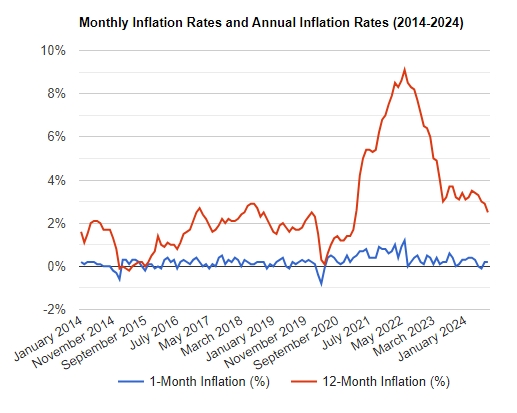
A lot of people are angry right now because prices are significantly higher than they were before the pandemic5. I touched on this topic for Economics a few weeks back. The bottom line is that the difference is significant and has had a meaningful impact on people’s lives. President Biden is the guy in charge, so responsibility is placed on him. During the campaign, former President Trump denounces President Biden, and Vice President Harris for causing this inflation with their big spending policies6. Harris, for her part, tries to dodge the issue and focus on plans for dealing with high housing prices. When she does mention inflation, she points out that under Biden’s policies inflation has decreased significantly since its peak in 2022. These arguments are then regurgitated by the relative political supporters, maybe by your own family members.
Yep. I hear it all the time. What’s the real story?7
The truth is, this issue is motivated by a Cognitive Bias called In-Group or Attribution Bias. In other words, we tend to attribute good stuff to our particular group, and bad stuff to the identified Out-Group. In this case, the In-Group and Out-Group represent political parties.
Here’s the unvarnished story.
President Trump took office in January of 2017. When he took office the economy was experiencing moderate and sustained economic growth. In 2020, economic growth fell off the table. We entered into a recession as the COVID Pandemic shut down economies all over the world. After the Pandemic, the United States, and the rest of the world experienced a huge surge in economic growth as economies revved up again. We also experienced a period of high inflation. In the United States, this inflation peaked in 2022 and dropped precipitously. Today, economic growth continues but has moderated, and inflation is down close to where it was BCP.
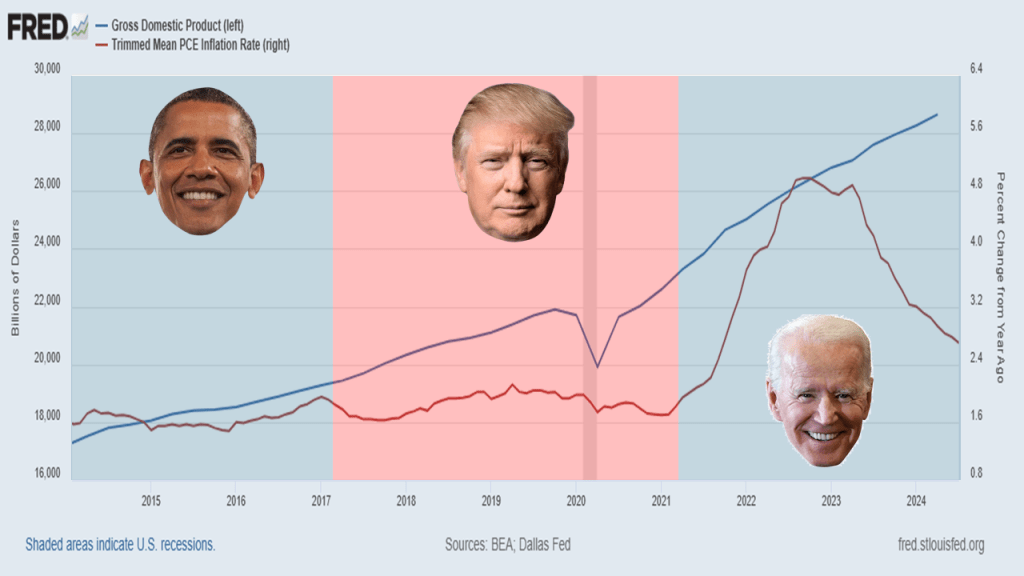
That’s the economic story with no political spin. Kinda boring.
So, who’s responsible?
Well, this is where we run into problems. You see, the political rhetoric is based on some Attribution Errors, in this case mistakenly “attributing” a particular cause (a President’s qualities) to an effect (state of the economy). Indeed, we have no information to suggest that a particular president caused a particular economic outcome. All we know is that a particular economic outcome happened at the same time as certain people served as president. With no further information, we cannot attribute cause.
Next, we engage in In-Group Biases.
First, positive economic outcomes are attributed to our candidate.
Secondly, negative economic outcomes are attributed to the other candidate.
Wait! …um…What?
Let me explain.
When Trump was elected, the United States was experiencing a period of moderate, sustained growth. Trump supporters attribute this to his economic acumen and management. The economy was good because Trump made it good. However, in 2020, the economy collapsed. Democrats blame Trump for his ineptitude in causing the recession. Trump supporters claim that their guy couldn’t be blamed for an economic response to the pandemic.
Okay, we want to give Trump credit for the growth, but he doesn’t get blamed for the recession. Why? This is a Cognitive Bias.
If you’re a Democrat, you shouldn’t feel smug. Democrats are not immune to this double standard. Harris and the Democrats claim that Biden was not responsible for the surge of inflation, but his policies were responsible for bringing that inflation down to manageable levels. That the economy continues to grow, despite our troubles, is due to Biden’s economic acumen. Again, he can take credit for the good news but defers blame for the bad.
Okay. I get it. So what’s the real story?
The real story is, of course, more complicated.
Of course, it is!
The Truth is, Trump is not to blame for the recession that happened in his term. That was caused by the pandemic. As the COVID was spreading, millions of workers were sent home to contain the virus. The economy was intentionally shut down, except for what was considered essential. This was the right thing to do in light of the fact that we didn’t know the full risks. Either workers would be sent home to avoid transmitting the virus, or workers would have been sent home because they were too sick to work…or dead. Either way, the economy was going to fall into recession.8
By the same criteria9 Biden is not to blame for the inflation that happened on his watch. It happened for two reasons. First, as we learned how to protect ourselves from the virus enough to make us comfortable returning to normal life, we had over a year’s worth of pent-up demand. We had money that we had wanted to spend for months, and we were ready to do so. Consequently, demand, especially demand for goods, skyrocketed.

At the same time, producers were not ready to provide the necessary supply to satisfy the demand. Think about it. You have a lumber business and suddenly you have orders for tons of lumber. But you haven’t actually produced any lumber for a year. It’s going to take time to hire your workers back, and get your machines up and running. You may need to purchase new parts, but those businesses are experiencing the same problems. Shipping vessels have to be manned and loaded and set to sea. Shipping containers that had been warehoused now have to be brought to the ports and filled. The global economy is a huge vessel and takes time to get going once it has been shut down.
Biden did not cause this. Had Trump been re-elected, he would have faced the same crisis.

Furthermore, Trump was not responsible for economic growth experienced before the pandemic. He took office at a time when that’s what the economy looked like. You can test this by looking at GDP between Obama’s and Trump’s presidencies cutting out the recessions and excluding the X-Axis. Can you tell where Obama’s presidency ends and Trump’s begins? Neither can I. There’s no difference.
And Biden didn’t end the inflationary period with his policies. Inflation came down as a result of three factors. First, demand subsided because we consumers used up the savings we accrued during the pandemic. Secondly, producers got up and running again as supply chain issues were resolved. Thirdly, the Federal Reserve applied brakes to the economy by raising interest rates. Higher rates decrease the incentive to borrow money, which slows the economy.10
It’s a political paradox. Typically, the President and the President’s party are credited or blamed for the status of the economy. In reality, however, Presidents have little control over how the economy functions.
Well, that doesn’t help at all! If it doesn’t matter, why vote?
Presidents can’t control what happens to the economy as a whole. They have very little say when it comes to economic booms,11 recessions, or inflationary periods. Stinky stuff happens. They can, however, be evaluated for what they do in response to these circumstances.
For instance, President Trump has one major legislative accomplishment before the recession. He signed the Tax Cuts and Jobs Act 2017. This was a massive tax cut, often criticized because it benefited the wealthiest citizens more than the rest. Regardless, taxes were cut, and most people like having their taxes cut. What was the impact of this law on the economy? Meh. It really didn’t do much. It did, however, increase the federal deficit significantly and continues to contribute to the national debt.
Another example of government intervention happened during the COVID Recession. By 2020 it was clear that COVID-19 would have a devastating impact on the economy. Between 2020 and 2021 many bills were passed providing funds to develop vaccines, increase production of masks and ventilators, and offer economic support and relief for the entire country including households and businesses.12 Conservatives criticized the laws as being drafted right off the Democratic Party wish list. Regardless, Trump did sign many of them and deserves credit13 for these pieces of legislation. He could have vetoed them. On one hand, these laws provided much-needed relief to millions of Americans. On the other hand, they were paid for through borrowing, increasing the deficit. Also, because this support allowed citizens to increase savings, they contributed to the inflationary crisis in 2021-2022. On the other hand, not enacting these laws would have meant significant human suffering and a more prolonged recession.
You will find that all economic policies are a mixed bag of costs and benefits. The question is, do the benefits outweigh the costs? Unfortunately, the answer is, “That depends on your priorities.”
So, how do we know what to give candidates credit for?
That’s actually a pretty easy question. Look at what the candidates actually done or propose to do. In other words, what laws were passed and signed? What executive actions were put into place? What policies are being proposed?
Then, ask yourself if these laws, or actions conform to the things you value. Values cannot be proven right or wrong. For instance, I supported all the legislation mentioned above because I’m concerned about human suffering. Relieving suffering is something I value. Indeed, I would like to see many of the COVID relief efforts made permanent.14 On the other hand, if the federal deficit is important to you, a balanced budget is something you value, then you might feel differently. Our differences in this case are not based on “the data” but rather on our priorities.
To make effective political decisions, regardless of the rhetoric, and in light of the fact that you have Cognitive Biases that prompt you into making irrational decisions, you must consider the things you value. What is the world that you would like to live in? What are the things happening in this world that stand in the way of your ideal?
Then do the research. What are the policies that could bring me closer to my ideal world? What are the costs of these policies? This latter question is a tough one because we have a cognitive bias to be blind to the costs of the things we desire. We have to be honest about the costs, and if we think the costs are worth the benefit.
Then we have to look at the actions taken by and the policies supported by the candidates. Which candidate will get me closer to my ideal world? It doesn’t matter if they are Democrats or Republicans. Male or Female. It doesn’t matter who you “like”. The chances are, you will never have root-beer with the President of the United States. You will, however, be impacted by his or her policies.
Finally, the really tough part. When a policy you support is passed and enacted, you have to ask yourself, “Did it work?” “Did this policy have the effect that I intended, and did the costs align with what I expected?” If the answer is no…you need to move on to a different idea.
Anyway. I hope this helps you make sense of all the finger-pointing and rhetoric you are experiencing as you enter into a long and fruitful period of political engagement.
Notes
- What’s the difference? I’m using Reaction as mostly instinctive, even biological. When you touch a hot stove you “react” by jerking your hand away. You do it without thinking. When you Respond to something (not to be confused with Behaviorist Stimulus/Response), you apply reason. You come up with a strategy. ↩︎
- You will never get rid of them. You will always be motivated by cognitive biases. They are intrinsic to being human. But you can mitigate their influence. ↩︎
- But sometimes someone is lying. Reliable fact checkers are invaluable. ↩︎
- This assumes that your town is fairly big, say a quarter of a million people. If you live in a town of 1000 people, four murders is really high! ↩︎
- The COVID Pandemic was a huge disruption in our lives. As is the case with most such disruptions, we often divide our understanding of the world based on the Pandemic as a turning point. We judge things today based on our memories of the way things were before the COVID Pandemic (BCP). This is a cognitive bias in and of itself, but that’s a post for another day. ↩︎
- He often refers to our current inflation issues as the “Worst in our nation’s history.” This is demonstrably untrue. Regardless, inflation is not fun to deal with. ↩︎
- You can examine the data on this yourself. I recommend using the Federal Reserve Economic Database, or FRED, when you need economic data. You can also get some good, valid, and reliable data from the Bureau of Labor Statistics, and many others. ↩︎
- I try to avoid making value judgements, but this one is a no-brainer. ↩︎
- And if we are going to control for our Cognitive Biases, we have to be consistent in applying our criteria. Your teachers do this by applying rubrics. That way there, your grade reflects your performance and not your teacher’s bias with regard to how much they “like” you. ↩︎
- So far, This is one of the biggest “policy” successes in a long time. The Federal Reserve wanted to slow down the economy enough to reduce inflation without causing a recession. Many economists thought this was impossible. I didn’t think it would work myself. But it looks like they may have pulled it off. The Fed is predicted to reduce interest rates in the next few days now that inflation is close to the target of 2%. Regardless, the Fed operates independently of the President. This success cannot be attributed to Biden. It should be noted that Former President Trump would like to appoint people to the Federal Reserve who would be answerable to the president. Is this a good idea? That’s something else you may want to research before you vote. Should the Fed remain independent of the government? ↩︎
- Like the one President Clinton gets credit for in the 90s, caused largely by the advent of the internet as a popular tool. By the way, the enthusiasm for the internet in the 90s caused a recession when the “Tech Bubble” burst in 2000. Clinton didn’t cause that, either. ↩︎
- For more information see the Coronavirus Preparedness and Response Supplemental Appropriations Act, Families First Coronavirus Response Act, Coronavirus Aid, Relief, and Economic Security (CARES) Act, Paycheck Protection Program and Health Care Enhancement Act, Consolidated Appropriations Act 2021, and the American Rescue Plan Act 2021. ↩︎
- Or blame. It depends on what you think is important. Every benefit has a cost. There ain’t no such thing as a free lunch (TANSTAAFL) ↩︎
- All of the provisions of these laws have since expired. They were never intended to be permanent changes. ↩︎
 Mr. A's Underground Classroom
Dear Mr Andoscia,
Thank you very much for broaching these highly consequential matters. Indeed, cognitive biases such as ingroup-outgroup bias and attribution bias can be as detrimental as confirmation bias. Worse still, in recent years, many citizens have willingly aligned themselves with misinformation, disinformation, post-truth politics, demagoguery, plutocracy, oligarchy, ochlocracy, kleptocracy, kakistocracy, narcissistic leadership, neoliberalism, globalization, clerical fascism and Trumpism. We can also agree that the ongoing chaos inflicted by the Trump presidency finally culminated in the infamous riot at the Capitol. You and I can be justified for being cynical, snide, snarky and facetious in characterizing Trump as the symbolic messiah who is going to lead his misguided supporters, sycophants and funders to glory on Earth and the promised land! It is often futile to reason with such misguided folks. Perhaps only when the country truly becomes autocratic or fascist, or when it plunges into a civil war, will such folks wake up, but then it will be too late. Consequently, any reasonable person can conclude that the USA has been plagued by ignorance, dogma, falsity, blind faith, spiritual stagnation and epistemological impasse . . . . .
Needless to say, due to misinformation and disinformation as well as the pandemic and other global issues, 2020 to 2022 as well as the past few years had been very difficult and trying, not to mention having to deal with the pandemic. It was all quite surreal, perhaps in some ways more bizarre than ghosts and the paranormal (not that I believe in such things). One could indeed say that we live in interesting times, but often for the wrong reasons. It is all quite a big mess in danger of getting bigger still. Even a global pandemic and an insurrection at the citadel of democracy still cannot unite folks in the USA and wake them up. Perhaps it will take an even bigger crisis to do so, such as a series of climate change disasters.
To make matter worse, even those who are supposed to know better, who are in the most privileged position or at the highest echelon, have displayed objectionable conducts, caused much disunity, and/or generated unwisdom. A supremely consequential example of such unfortunate degeneracies has been discussed in a very detailed and multipronged approach in my eye-opening post entitled “🏛️⚖️ The Facile and Labile Nature of Law: Beyond the Supreme Court and Its Ruling on Controversial Matters 🗽🗳️🔫🤰🧑🤝🧑💉“, published at
In the post, I have investigated the fundamental issues and also offered some far-reaching solutions, some requiring profound soul-searching as well as genuine compromise and rapport with the “other” through compassion and mutual understanding. I welcome your input and am curious to know what you make of my said post as well as your perspectives on those matters discussed in my post, where I look forward to savouring your feedback.
Once again, thank you very much for your continual efforts in highlighting many sociological issues.
Wishing you a wonderfully productive mid-October doing or enjoying whatever that satisfies you the most! Take care and prosper!
Yours sincerely,
SoundEagle🦅
LikeLike