

Part 1: The Greenhouse Effect and Global Warming

It’s so darn hot!
Curriculum Specifics
- Course: Geography, Earth Science, Histoyr
- Education Level: 10th Grade
- For eighth Grade version (AI Altered)
- For Sixth Grade version (AI Altered)
- Reading Level: 10th Grade
- Reading Time: 15 minutes
Introduction
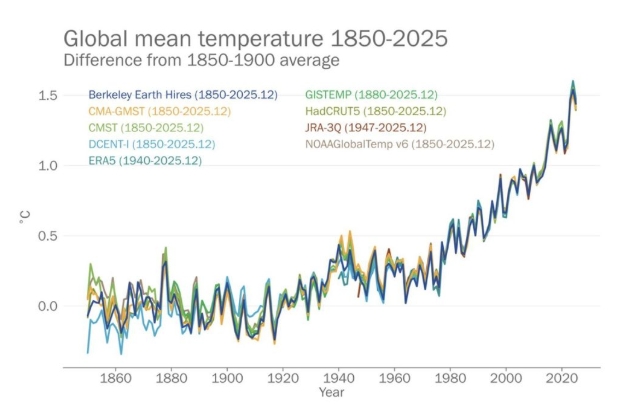
Man! It’s hot out! Is it just me or is the world getting warmer? We have fires all over the place. Water rations. Once in a lifetime heat waves every freakin’ year. What the heck?
It’s not your imagination. It is, in fact, getting hotter. In fact, the eleven hottest years on record were the last eleven years. And as of February, 2026 is projected to be among the hottest. February! Like, two months into the year and it’s already on course to be one of the hottest on record.
You are not the only one noticing. There’s actual science to back up your observations. Multiple scientific organizations are keeping track of the trends, and they all report the same outcomes. The world is getting hotter.

Vocabulary
- Greenhouse Effect
- First Law of Thermodynamics
- Industrial Revolution
- Combustion
- Law of the Conservation of Matter/Mass
- Greenhouse Gases
- Global Warming
- Global Climate Change
The Greenhouse Effect
Wow! Why is this happening?
It’s a thing called the Greenhouse Effect. This is a crucially important phenomenon to understand.
You see, back in 1824, a French Mathematician and Egyptologist…
Wait! Mathematician AND Egyptologist?
Just go with me on this.
…ahem…
Back in 1824, a French Mathematician and Egyptologist named Joseph Fourier was studying heat. He looked at the amount of heat energy the Earth received from the Sun, did some calculations, and noticed that there was not enough Solar Energy to account for the Earth’s temperature. He theorized that the atmosphere must be holding a certain amount of heat in much the same way that glass holds heat in a greenhouse.
In 1856, an American scientist named Eunice Foote identified CO2 and water vapor as the heat holding culprits. Three years later, an Irish physicist named John Tyndall confirmed her observations with more sophisticated lab equipment.1
The Greenhouse Effect works like this.
First, you have to understand something called the First Law of Thermodynamics. This law of physics states that energy cannot be created or destroyed. Energy can only be transformed from one form to another. It’s really a pretty cool law. In essence, the energy that is in your body right now, is exactly the same energy that has existed since the Big Bang!
That is pretty cool!
Right!
Anyway, when sunlight arrives at the Earth, it does so in the form of shortwave radiation and passes through the atmosphere with little resistance. When it strikes the surface, however, there’s resistance. That shortwave radiation is transformed into longwave Infrared Radiation, what we call heat. This heat is radiated back into the atmosphere.
Ever walk barefoot over beach sand, or a paved parking lot, especially a dark, fresh laid macadam on a sunny day? Burns, don’t it? Your head isn’t burning from the radiation from the sun hitting it, but your feet are sure burning from the heat radiating from below.
That heat rises. Some of it is lost to molecules in space. But a great deal of it is held by the Carbon Dioxide and the water vapor in the atmosphere. The heat that is held by the CO2 and H2O molecules ends up being re-radiated through the atmosphere.
You can do this experiment on your own. In a journal, take notes throughout the year on the difference in temperature in the evening as compared to the daytime. Also keep track of the humidity for each day. You will notice that humid days often translate to warmer nights. Dry days offer much cooler nights.
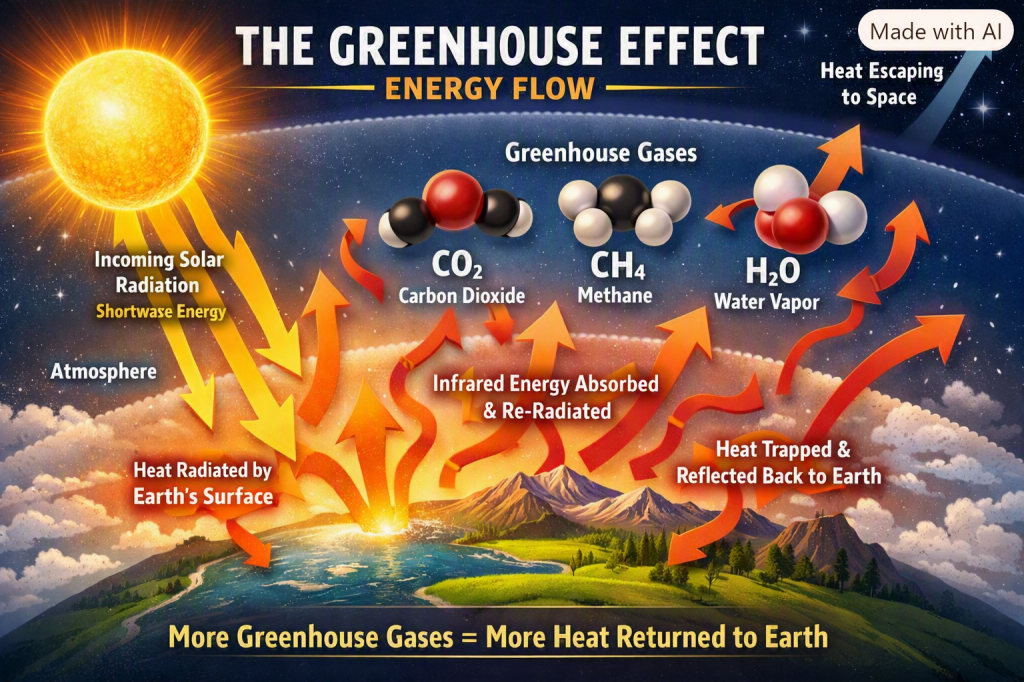
The greenhouse effect is the reason that the Earth isn’t a giant ice ball with periodic pockets of liquid water here and there. Life on earth, if it could have existed at all, would have evolved very differently if not for the Greenhouse Effect.
Human natural history has also been influenced by the Greenhouse Effect. In the quarter of million to three-hundred-thousand-year history of Homo Sapiens, the Earth has gone through a number of cooling cycles culminating in ice ages, and then warming cycles. Human history has emerged during a period of natural warming since the last ice age. This has been a huge benefit, making agriculture possible for sustaining large populations. Human civilization as we know it has really emerged in a climatological Goldilocks zone in which, for the most part, global temperatures have been “just right.”2
The Burning Question
So, what went wrong?
Well. It’s not so much a matter of things going wrong. It’s just that sometimes there are unforeseen consequences of things going right.
As a result of the Black Plague in the fourteenth century, human beings started to innovate technologies for getting work done without a lot people around to apply their physical labor to what needed to get done. Some really clever people created some innovative contraptions that did a lot of work by using other sources of energy rather than human muscle. Often, this energy came from moving water, in the form of water wheels, or wind in the form of windmills. Turning wheels became the foundation of nascent machine factories. The wheel would turn pullies and levers and fulcrums. Innovative engineers found ways to use these basic tools for a lot of different products, not the least of which was milling grain, or spinning cloth.
This was, arguably, the birth of modern manufacturing.
As this technology improved over the span of about four hundred years, engineers started experimenting with other sources of energy. Namely, they learned to access the energy from “ancient sunlight.”3 In other words, they released the energy stored for millions of years in fossil deposits found in the ground. That is the ancient plants and animals that died millions of years ago resulting in the carbon of their bodies being condensed into rock and oil by Earth Processes.
Fossil fuels!
Bingo!
It really started with coal. Those nations with vast coal deposits, like Britain, France, Germany, and the United States had a fuel source with tremendous potential. Coal could be used to fuel newly developed steam engines that became the keystone technologies for our factories, railroads, and steamships. Human ingenuity was no longer determined by the wind or river currents. We could access ancient sunlight to fire our manufacturing and transportation, creating new goods, and bringing those new goods to vast markets.
The result was the Industrial Revolution.
There was another source of ancient sunlight, however. It was this inconvenient black goo that seeped up from the ground, making everything yucky. Most people hated it. However, it did have one valuable property. I caught fire really easily. Edwin Drake, working for the Pennsylvania Rock Oil Company, found vast reserves of oil seeping through the ground in the Keystone State. The oil industry was born and transformed the global economy. The technologically advanced society that we all take for granted is the direct result of this oil economy.
Unfortunately, this is where the problem starts.
To understand why this is a problem, you need to understand what “Burning” is.
I know what burning is. I touch the round thing on the stove, I burn my hand.
How many times did it take you to learn that?
I’d rather not say.
Fair enough.
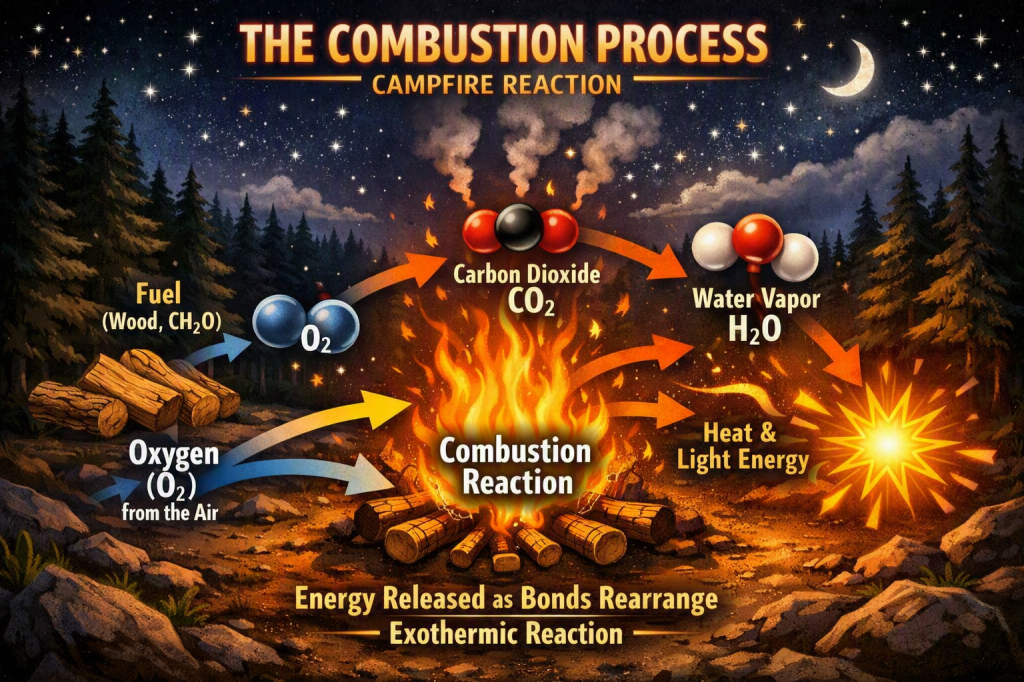
In fact, burning, or rather combustion, is a specific chemical process. It’s the result of adding oxygen to an element. Here’s how it works in a nutshell. Let’s take an element like Carbon (C). This little element loves itself some Oxygen (O). Add a little heat and that Carbon atom reaches out and grabs up a couple of Oxygen atoms. Now Carbon, by itself, holds a certain amount of energy. Oxygen also holds a certain amount of energy.4
When the Carbon grabs onto those Oxygen atoms, you get combustion. We write it like this:
C + O2 —> CO2
That’s a Carbon Dioxide molecule. A CO2 molecule doesn’t require nearly as much energy to hold it together as any one Carbon or Oxygen atom. So, when these atoms come together, they shed the excess energy in the form of light, the yellow/orange flame of your campfire,5 and heat, the stuff that toasts your marshmallow. By the way, the crackling and sparks coming from your campfire is often the result of trapped water expanding into water vapor and expanding from the wood.
That’s Pretty Cool!
Next time you go camping, you’ll have something to talk about.
Hmmm. No.
Anyway, there’s one more physical law you need to know to understand this phenomenon.
When did this turn into a science lesson?
That’s the thing. To be a good historian and social scientist, you need to know everything!
The law is The Conservation of Matter/Mass. You see, just like energy can neither be created nor destroyed, matter can’t either. Again. Pretty cool. The stuff your body is made of has been around, in different form, since The Big Bang!6
The Problem
Here’s where this becomes problematic. The history of industrialization, which has improved the lives of billions of people and has transformed human existence in many incalculably beneficial ways, did so at a significant physical cost. You see, to fuel our industries we took solid (coal) or liquid (oil and gas) hydrocarbons (combinations of hydrogen and carbon molecules) that were safely sitting in the ground and burned them. In so doing, we turned them into a gas and put them into our atmosphere. The carbon and hydrogen don’t disappear, it is just transformed into another state.
Think about the countless tons of carbon and hydrogen we’ve burned in the last two hundred years. Some of it has seeped from the atmosphere. Some of it taken up by plants and trees. But a great deal of it is still up there.
And these are what we call “Greenhouse Gases.” In other word, they are really good at holding and emitting heat. Unfortunately, we are dumping these greenhouse gases into the atmosphere faster than they can be extracted. These gases keep building up. In 1958, a guy named Charles Keeling started keeping meticulous records on the amount of CO2 in the atmosphere. The resulting Keeling Curve is one of the most important points of data in this debate.
As you can see in the video above, carbon keeps building up in the atmosphere. So, what can you infer from that?
The more carbon and greenhouse gases in the atmosphere the hotter the world is going to get?
Are you asking me or telling me?
Come on!
Okay. Yes. You are right. As greenhouse gases build up in our atmosphere, the more heat will be held and radiated back to the surface, causing the entire world to get warmer. This is what scientists mean by Global Warming. The impacts of global warming on our climate is referred to as Global Climate Change.
Well, this seems too sensible. I mean, if I can figure it out, couldn’t scientists a long time ago have put this together?
They did. Back in 1896, a Swedish scientist named Svante Arrhenius did the first solid calculations estimating the rise of global temperatures as a result of greenhouse gases being dumped into the atmosphere. So, we’ve had direct evidence confirming the Global Warming Theory for a hundred and thirty years.7
Where Do We Go From Here?
Well, then obviously in that time we’ve been working on solutions to this calamitous problem?
Weeeeeellllll!
Oh, come on!
It’s complicated, and a topic for Part II of this lesson. In the last fifty years or so there has been a great deal of movement on this topic. Millions of people are participating in social movements for the sake of reversing these trends. They are trying to get their political decision makers to make better decisions with regard to Global Climate Change. And there have been some important victories.
That’s great!
Weeelllll! Why don’t you go outside and come back in and tell me if you think it’s enough.
[Waiting…Waiting…Waiting]
Yuck! It’s not enough! Not enough by a long shot!
Yeah. Furthermore, there’s evidence to suggest that we are running out of time to deal with this problem before the heating becomes self-sustaining. This is referred to as a tipping point. Once we reach that tipping point, all that will be left is for humanity to try to adapt to a world rapidly changing into something we did not evolve to live on.
But that’s another debate, and it’s one we should have. Look, the bottom line is that the science I just elaborated above is not up for debate. Greenhouse gases are being dumped into the atmosphere. They are building up. The laws of physics are clear that this process will result in a warmer planet. These are facts. Period.
There may be some debate on the predictions regarding the trends and where those trends are likely to go. But there is no debate that the trends are getting worse. Just how much worse they are going to get.
And the larger debate is, what do we do about?
Those actual debates will be the topic of the next lesson.
Footnotes
- That Eunice Foote was the first to make this discovery, but Tyndall got the credit is pretty contentious. To what extent was sexism responsible for Foote’s discoveries being ignored? Tyndall did have the better set-up and was affiliated with the Royal Institutions in London. So, was it sexism? Was it connections? Better PR? There is, however, no evidence that Tyndall knew of Foote’s experiments ahead of time or that he intentionally undermined her discovery. ↩︎
- This phenomenon was not linear. There were variations of warming and cooling since the last ice-age that had serious impact on human history. Not the least of which was a period called The Little Ice Age. ↩︎
- I love this descriptor, which I first saw in Thom Hartmann’s book, Last Hours of Ancient Sunlight. An interesting read. ↩︎
- “Holds a certain amount of energy” is a bit of a simplification here. Ask your chemistry teacher to elaborate. ↩︎
- Actually, pure carbon, burning completely, burns blue. The yellow/orange is because the combustion isn’t complete and there’s other particles in there…but that’s for your science teacher to talk about. ↩︎
- Look up Carl Sagan and “Star Stuff” for a more complete explanation. ↩︎
- It should be noted that Arrhenius didn’t have a problem with this. Don’t forget, he was coming off The Little Ice Age. From his perspective, a little global warming could be a good thing. Of course, he didn’t realize that he process of burning fossil fuels was just getting warmed up (get it! see what did there!). ↩︎

