
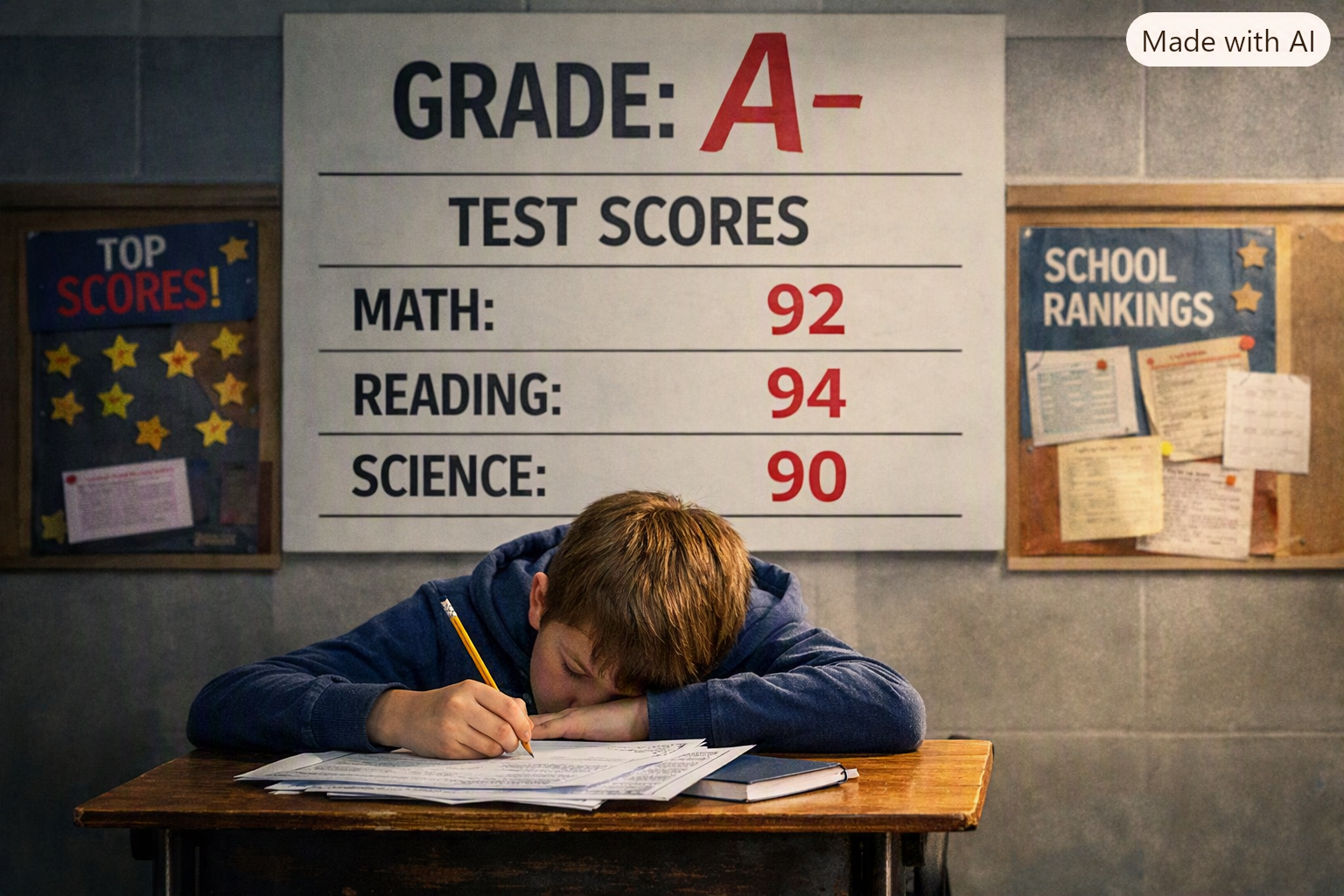
What Will the Costs to our Children be to get those District Grades Up?

Years ago, I attended a lecture by the acclaimed education researcher and reform advocate Alfie Kohn. He said something that I always took to heart when our admin would review our test scores and school grade breakdown every year. He said, “There are two reasonable responses to news that test scores have increased. The first is the more moderate response. The second is more radical.”

For more information about Alfie Kohn, see his work at alfiekohn.org
The more moderate response is, “So what?”
The truth is there is little evidence that standardized test scores reveal anything about actual learning. If anything, the multiple-choice laden exams may offer a temporary snapshot of the content a student could remember when taking the exam. Think about it. How much content do you actually remember from high school, let alone middle and elementary school?
This essay was originally published in the Fort Myers News-Press. Click here to see the original essay and to support local journalism. Correlation between test scores and actual learning is weak | Opinion
The formulaic writing evaluations offer exactly zero insight into how well students can think and support a thesis. Rather they are better measures of how well the student conforms to the orthodoxy necessary for writing the same old five paragraph essay over and over again.
Standardized test scores offer very little in the way of useful information. Whether or not the scores went up or down often has more to do with exam competence, the mind-numbing “test-taking skills” our students waste immeasurable time mastering. It turns out that in adulthood such skills are meaningless to anyone’s real life. If you are over thirty, how often have you used “test-taking skills?”
Lower scores are likely the result of the tests being re-normed or redesigned. Test scores don’t even necessarily correlate to other test scores.
In fact, a wealth of research on the topic shows test scores are most useful if one is trying to guess what size house a student lives in. Other than that, the correlation between test scores and learning is pretty weak. Furthermore, such assessments say nothing about higher level thinking skills like critical analysis, evaluation, and creative thinking.
The more radical response is, “Dear God, No! What did you deny my child’s education to raise those test scores?”
If the fate of students, teachers, schools, and districts rests on so-called “objective measures” revealed by test scores and school grades—especially if money is on the line—incentives get twisted. The myriad experiences students might have in school gets winnowed down to what is going to raise test scores. Students who are talented artists or musicians find themselves losing out on art and music classes because they must double up on Language Arts or Math to raise their scores. Not to learn! Not to be more well rounded human beings! No. They must raise test scores. The needs of the child become secondary to the needs of the school to raise those school grades. And don’t think this is lost on the students.
I taught history for many years. During one workshop on a new U.S. History End of Course Exam one of the presenters pointed out that there were no questions on the Progressive Movement of the late 19th and early 20th century. He advised, “don’t bother teaching it.” It’s part of the state curriculum, but that didn’t matter. It’s not on the test. Scratch it.
Recent reporting shows that young people are no longer reading novels or long-form non-fiction. When required to do so in college courses, they seem incapable of the kind of focus and retention necessary to succeed. Rose Horowitch, in her essay in the Atlantic, The Elite College Students Who Can’t Read Books, points out, “middle- and high-school kids appear to be encountering fewer and fewer books in the classroom…” A teacher quoted in the article observed, “There’s no testing skill that can be related to … Can you sit down and read Tolstoy?” Standardized test-taking skills rests on the students’ ability to pull information from short excerpts. So, that is the skill that is drilled.
I’ve noticed similar trends in social studies education. Those of us of a certain age remember when every history class culminated in at least one research paper complete with proper citation. Emphasis on “covering the curriculum” for the sake of state testing, however, makes it impossible to dedicate the necessary time and energy to the yearly research paper ritual. Consequently, college history professors are looking at incoming students who have never written more than the formulaic five-paragraph essay. In a larger social context, we have a generation of people who have no practical experience with “doing their own research.” Ironically, many of them claim to do exactly that online.
Throughout the country we are watching the loss of recess time, shortened lunch periods, the loss of arts, music, and inspiring electives. Students read fewer books, and write shorter, less meaningful expositions. Meanwhile, teachers are leaving the field. Potential teachers are going into other fields. We compensate by cramming more students into fewer classes with fewer adults credentialed in their fields.
Overall, we are spending more time doing less enriching, less thought provoking, lower-level thinking for the sake of raising test scores and their corresponding school grades. This constitutes an irreparable theft from our children. Recent research into cognitive development and health is just now starting to reveal the devastating impact such practices have on our children.
So, when Robert E. Lee School District Superintendent Dr. Denise Carlin announced that her goal was to raise Lee County to an “A” District, with no schools scoring lower than a “B”, I was reminded of the more radical element of Kohn’s lecture. Dear God, what is she going to strip away from our children to get those objective measures where she wants them?
We already have a partial answer to this question. Many parents are asking how it is that our graduation rates have increased, and yet our proficiency scores remain stagnant. It is no secret that the graduation rate is a component of our school and district grades. Are we lowering requirements to boost graduation rates? To what extent does a devalued high school diploma rob students of the credentials they need, and many deserve, as they enter their next chapter of life?
This is not meant to be a screed against Superintendent Carlin. She must make decisions for this district based on the backward, intellectually shallow rules legislated by the state. However, Lee County’s vision is to be a “World-class school system.” Its mission is to “ensure that each student achieves his or her (I would also say ‘their,’ but…) highest personal potential.” I think everyone agrees that these are worthy goals. Unfortunately, Florida state legislation and policy is focused on school grades and so-called objective measures.
Unfortunately, what it means to be a world-class school system and to fulfill one’s highest personal potential cannot be objectively measured. In fact, what it means to raise school grades and what is required to create a world-class school system are in most ways mutually exclusive. We, the citizens of Lee County, can have a world-class school system, or we can have a higher district grade. We can’t have both. Which would you prefer?
Shameless Self Promotion!
My paid subscriptions are inexpensive. At this point, for the price of a hardcover you get access to my novel, The Revelation of Herman Smiley. Substack is, at this point, the only place you can read it. Also, be the first to read and comment on my novel Abode. You also get access to my short fiction like Walter’s House, and my long form research projects coming shortly, including Teaching Heresies, and Democracy is of the Streets.
Not bad! Huh?
So, help an aspiring writer out and sign up for a paid subscription.


You can also purchase my novel Stone is not Forever. It’s an epic immigration story.